
The Houston Astros and Kansas City Royals are headed for a decisive Game Five tonight. On Monday in Game Four, the Astros held a 6-2 lead and were just six outs from advancing to the ALCS. With one out in the bottom of the seventh, the Royals had a 0.8% series win expectancy. If Kansas City wins tonight, their comeback will go down as one of the greatest in postseason history. If they lose, it will be all for naught.
The following are the fifteen biggest comebacks in postseason history according to series win expectancy. These are comebacks from the brink of elimination, so you will not see single game comebacks such as Game Four of the 1929 World Series when the Athletics scored ten runs in the seventh inning after being down 8-0. This is because Philadelphia was not close to elimination.
15) 2012 NLDS
Giants defeat Reds (7.0% series win expectancy)

Background:
In 2012, MLB added a second wild card. To fit the wild card game in between the end of the regular season and the beginning of the division series, they changed the format of the division series from 2-2-1 to 2-3 in order to eliminate an extra travel day. This made it more difficult for the Giants, who lost both games at home and would have to win the final three in Cincinnati.
Low Point:
During the second inning of Game Three, the Reds held a 1-0 lead. Cincinnati was just seven innings from completing the sweep against the Giants.
The Outcome:
The Giants tied the game and that score remained until extra innings when the Reds scored on an error to force a fourth game. San Francisco never trailed during Game Four and the big blow came in the fifth inning of Game Five on a Buster Posey grand slam off of Mat Latos.
14) 1992 NLCS
Braves defeat Pirates (6.6% series win expectancy)

Background:
This was essentially the Pirates last opportunity at a World Championship. The nucleus of the team that lost both the 1990 and 1991 championship series was breaking apart. Barry Bonds and Doug Drabek were all but gone at the end of the season because the Pirates wouldn’t be able to compete with large market clubs in free agency.
While the Braves, with one of the best farm systems in baseball and the backing of billionaire owner Ted Turner, were looking for their second straight World Series appearance.
Low Point:
Going into the bottom of the ninth during Game Seven, Atlanta was down 2-0. They were facing Doug Drabek, who was just three outs away from a complete game shutout.
The Outcome:
The Braves quickly loaded the bases on a double, error, and a base on balls. Pirates manager Jim Leyland brought in his closer, Stan Belinda, in hopes of stopping the rally. Atlanta scored their first run on a sacrifice fly and reloaded the bases on a Damon Berryhill walk. A popout by pinch hitter Brian Hunter gave the Pirates their first out. With the pitcher’s spot due up, Braves manager Bobby Cox went with Francisco Cabrera, who had just eleven plate appearances all season.
In the outfield, Pirates center fielder Andy Van Slyke motioned to left fielder Barry Bonds to move in a few steps. Bonds did not oblige and it proved to be costly. Cabrera singled to left, easily scoring David Justice. Sid Bream rounded third as Bonds fielded the ball and threw home. The throw was a little off-line and Bream was safe by inches. Had Bonds moved in, most baseball fans might not be able to recognize Francisco Cabrera’s name.
13) 2003 ALCS
Yankees defeat Red Sox (6.0% series win expectancy)
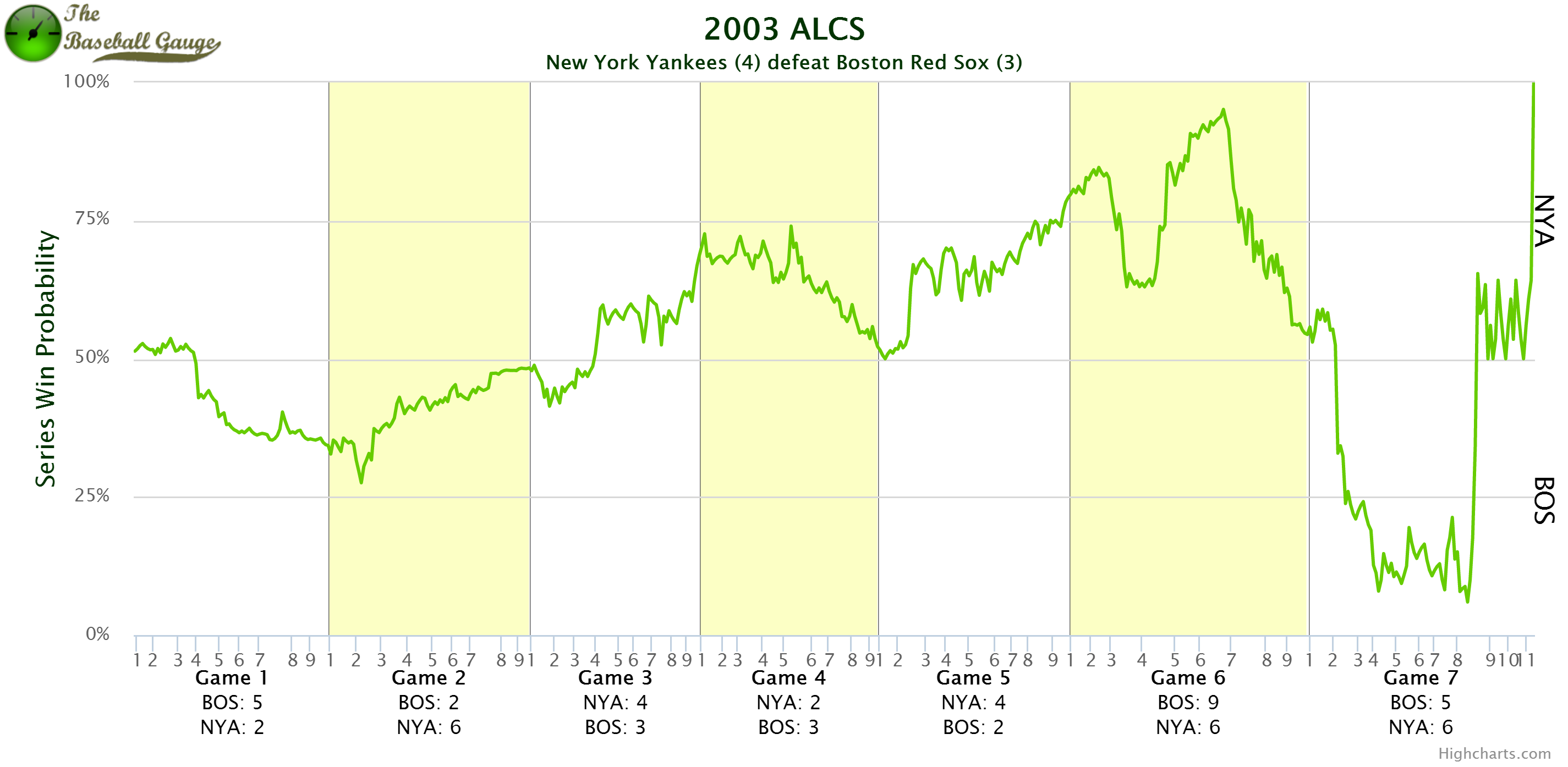
Background:
It had been 85 years since the Red Sox last won a World Series. During that time, the rival Yankees had won 26 World Championships. It was known as “The Curse of the Bambino” and the Red Sox were going to have to get through their rival to end the suffering. The series was everything that Fox could have dreamed for and more. The two biggest markets, literally fighting their way to the World Series.
Low Point:
In the bottom of the eight in Game Seven, the Yankees were down 5-2 with just five outs remaining. On the mound for Boston was Pedro Martinez, who was going through arguably the most dominant stretch by any pitcher in baseball history.
The Outcome:
After the Yankees quickly scored their third run, Red Sox manager Grady Little went to the mound, but ultimately chose to stick with Martinez, rather than go with late inning relievers Mike Timlin or Alan Embree. The decision would ultimately be the defining moment in Little’s career as the Yankees tied the score just two batters later.
The game went into the 11th when Yankees third basemen Aaron Boone hit just the second pennant-clinching walk-off homerun in LCS history.
12) 1960 World Series
Pirates defeat Yankees (5.9% series win expectancy)

Background:
This was the classic David vs Goliath matchup. The Yankees were in their eleventh World Series in the last fourteen years while the Pirates were the champions of the senior circuit for the first time in 33 years. While the two teams split the first six games, the Yankees had outscored the Pirates 46-17.
Low Point:
In the top of the eighth in Game Seven, the Yankees scored two runs to increase their lead to 7-4. The Pirates had just six outs remaining vs Bobby Shantz.
The Outcome:
The bottom of the eighth began with three straight singles, which cut the lead to two. Yankees manager Casey Stengel replaced Shantz with Jim Coates, who then retired the first two batters he faced. Roberto Clemente followed with a single that cut the lead to one. That brought up backup catcher Hal Smith, who entered the game in the sixth inning. At the beginning of Smith’s plate appearance, the Pirates had a series win probability of 29%. Five pitches later, Smith hit the biggest series changing homerun in baseball history. The three-run shot gave the Pirates a 9-7 lead and a series win probability of 94%.
Unfortunately for Hal Smith and the Pirates, the Yankees scored two in the top of the ninth to tie the game. What followed would be the first World Series clinching Walk-Off homerun in history. The highlight of Bill Mazeroski dodging Pirates fans while waving his helmet around would be seen countless times by baseball fans. All while Hal Smith’s contribution would go largely forgotten.
11) 1995 ALDS
Mariners defeat Yankees (5.7% series win expectancy)

Background:
The Mariners shouldn’t have been in the playoffs. On August 15th, they were 12.5 games behind the division leading Angels and had a 0.4% chance of winning the division. Over the final month and a half of the regular season, they battle back and won a one-game tiebreaker.
Low Point:
During the third inning of Game Four, the Yankees were up 5-0 and just six innings away from advancing to the ALCS.
The Outcome:
Seattle quickly scored four runs in the fourth inning and eventually took the lead for good in the eighth inning of Game Four, forcing a deciding Game Five.
Through seven innings of Game Five, New York held a 4-2 lead. Their starter David Cone, had thrown 118 pitches and went back to the mound to face the heart of the Mariners order in the eighth. A Ken Griffey Jr solo homerun and a Doug Strange bases loaded walk tied the game.
Randy Johnson, who had thrown seven innings just two days before, came in the ninth inning to stop a Yankees rally and then struck out the side in the tenth. The Yankees would finally get a run across on him in the eleventh, moving just three outs away from a series victory.
The bottom of the eleventh would go on to be arguably the greatest moment in Mariners history. Facing New York’s ace, Jack McDowell, Seattle would get back-to-back singles by Joey Cora and Ken Griffey Jr. Designated Hitter Edgar Martinez would follow with a two-run double down the left field line as Griffey came around to score the winning run. The 1995 Mariners created so much excitement in Seattle, they are often credited for saving baseball in the city, as they would soon get funding for what would become Safeco Field.
10) 2012 NLDS
Cardinals defeat Nationals (3.7% series win expectancy)

Background:
After so many years in the basement of the National League East, Washington was finally benefiting from multiple early first round draft picks. During the regular season, they won a franchise record 98 games. The Cardinals were defending World Series champions and in their ninth postseason in the previous thirteen years.
Low Point:
The two clubs split the first four games, going into a deciding Game Five in Washington. The Nationals jumped out to a 6-0 lead, hitting three homeruns in the first three innings on Cardinals ace Adam Wainwright.
The Outcome:
St. Louis slowly chipped away, scattering five runs in the next five innings. They would go into the top of the ninth down by two, facing the Nationals closer Drew Storen.
A double and two walks loaded the bases with two outs. Daniel Descalso singled in two runs to tie the score and Pete Kozma singled in two more to take a 9-7 lead. Cardinals closer Jason Motte provided a perfect bottom of the ninth to advance to the NLCS.
9) 1980 NLCS
Phillies defeat Astros (3.6% series win expectancy)

Background:
The Phillies, who have been in existence since 1883, were still looking for their first World Series championship. They had lost three of the last four NLCS.
Low Point:
During Game Four, in the bottom of the sixth inning, the Astros were leading 2-0 and had just loaded the bases with just one out. Houston was just three innings away from appearing in their first World Series.
The Outcome:
With right-handed batter Luis Pujols coming up with the bases loaded, Phillies manager Dallas Green chose to replace his ace Steve Carlton with right-handed reliever Dickie Noles. Pujols then flew out to rightfielder Bake McBride, scoring Gary Woods from third on the sacrifice fly. However, several Phillies noticed that Woods left the base before McBride made the catch. An appeal followed and Woods was declared out and the run was taken off the board, ending the inning.
Philadelphia then scored three runs in the eighth before allowing Houston to tie it in the ninth, forcing extra innings for the third straight game. In the tenth, two runs on a Pete Rose single, and doubles by Greg Luzinski and Manny Trillo put the Phillies up for good.
Game Five would be the fourth straight extra inning game. There were four lead changes with each team having at least a 90% probability of winning before blowing their lead. The 1980 NLCS would go down as one of the most exciting postseason series in baseball history.
8) 2014 AL Wild Card
Royals defeat Athletics (3.2% series win expectancy)

Background:
The Kansas City Royals had not appeared in the postseason since 1985
Low Point:
Through seven innings, Oakland was ahead 7-3 with their ace Jon Lester on the mound.
The Outcome:
In the eighth, the Royals cut the deficit to one run by scoring three while stealing four bases on Oakland’s backup catcher Derek Norris, Jon Lester, and Luke Gregerson (who replaced Lester midway through the inning).
In the bottom of the ninth, the Royals manufactured the tying run with a Josh Willingham single, another stolen base by pinch runner Jarrod Dyson, and a sacrifice fly by Nori Aoki. The game would remained tied until the twelfth when Oakland took another lead with a walk, wild pitch, and single. Kansas City would have to mount yet another come back. A Christian Colon single scored Eric Hosmer (who tripled) to tie the game. Colon stole the Royals seventh base of the game to get into scoring position. Finally, catcher Salvador Perez singled in the winning run down the left field line, advancing Kansas City to the division series.
For a much more detailed account, you’ll certainly enjoy Andy McCullough’s The night Kansas City baseball came back to life.
7) 1968 World Series
Tigers defeat Cardinals (2.8% series win expectancy)

Background:
1968 was the year of the pitcher. Cardinals ace Bob Gibson posted a ridiculous 1.12 ERA while Tigers hurler Denny McLain became the first 30 game winner since Dizzy Dean in 1934.
Low Point:
St. Louis took three of the first four games of the series. In the fourth inning of Game Five, they held a 3-0 lead and had two runners aboard with just one out.
The Outcome:
On the mound for Detroit was Mickey Lolich, who would throw three complete games during the series and earn MVP honors. Lolich would quickly stop the threat in the fourth inducing a flyout and a strikeout. In the bottom half, the Tigers cut the lead to one with two triples, a sacrifice fly and single. They would take the lead for good in the seventh and force a Game Six (which was a 13-1 Tigers blowout).
Game Seven looked like a classic pitchers duel between Lolich and Gibson, with each club scoreless through six innings. In the top of the seventh, Gibson got two quick outs before Detroit started to rally. Norm Cash and Willie Horton each singled, but the big blow came on Jim Northrup’s two-run triple. Detroit held on to the lead and won their first World Series since 1945.
6) 2003 NLCS
Marlins defeat Cubs (2.2% series win expectancy)

Background:
The Cubs had not won a World Series since 1908 and had not won a pennant since 1945, while the Marlins were looking for their second World Series appearance in their eleventh season.
Low Point:
In the top of the eighth in Game Six, the Cubs held a 3-0 lead and were just five outs away from returning to the World Series.
The Outcome:
After getting the first out of the inning, Cubs pitcher Mark Prior allowed a double to Marlins leadoff hitter Juan Pierre. The next batter, Luis Castillo lofted a flyball down the leftfield line in foul territory. In what would forever be known as the “Steve Bartman Incident”, Cubs leftfielder Moises Alou leaped at the wall, only to have the ball deflected by a fan going for the souvenir. Alou was visibly upset because it would extend the at bat, which turned into a base on balls. The next batter, Ivan Rodriguez singled in Pierre, cutting the lead to two runs.
The next play is the most pivotal of the series, and should be more infamous than the Steve Bartman interference. Marlins rookie Miguel Cabrera hit a routine groundball to shortstop Alex Gonzalez. It’s possible the Cubs could have turned an inning ending double play. At the least, they could settle for one out. But Gonzalez misplayed the ball, and the error loaded the bases with just one out. Seven more runs would score in the inning and the Marlins would live to see another day.
Game Seven got off to a poor start for the “North Siders” as Miguel Cabrera hit a three-run homerun off Kerry Wood. But that lead wouldn’t last long as the Cubs scored three in the second to tie it and another two in the third inning to take the lead. The Cubs were now eighteen outs away from the World Series. Whether it was the “Curse of the Billy Goat“, bad luck or poor performance, the Marlins re-took the lead for good in the fifth inning, advancing to the Fall Classic.
5) 2011 World Series
Cardinals defeat Rangers (2.1% series win expectancy)

Background:
The Rangers were back in the World Series after losing in 2010 to the Giants. The Cardinals were in their eighth postseason in the previous twelve years.
Low Point:
In the bottom of the ninth inning of Game Six, the Rangers led 7-5 and were just two outs away from a World Series championship.
The Outcome:
Facing Texas closer Neftali Feliz, Albert Pujols doubled into the left-centerfield gap. The next batter, Lance Berkman drew a four-pitch walk, putting the tying run on base. Feliz got Allen Craig to strikeout for the second out of the inning. The Rangers outfield was playing deep in hopes to limit any hit to a single. Unfortunately, rightfielder Nelson Cruz was not playing deep enough as David Freese lined a ball just out of his reach and off the wall, bringing in both runs and to tie the score.
The Cardinals “momentum”, however, was short lived as in the top of the tenth inning, Josh Hamilton hit a two-run homerun off of Cardinals closer Jason Motte. Surely this would be enough to give the Rangers their first World Championship. But in the bottom half, the Cardinals manufactured two runs on three singles, a sacrifice bunt and an RBI groundout. The game was yet again tied.
After Jake Westbrook held the Rangers scoreless in the top of the eleventh, ninth inning hero David Freese came to plate. On a full-count and the seventh pitch of the at bat, Freese hit a walk-off homerun to dead center, forcing a Game Seven. As the ball cleared the fence, play-by-play announcer Joe Buck told the audience “We will see you tomorrow night”. This was a nod to his late father, who twenty years earlier in the 1991 World Series used the same line when Kirby Puckett hit a walk-off homerun.
In Game Seven, the Rangers once again took a two-run lead in the first inning on doubles by Josh Hamilton and Michael Young. The lead would be short-lived as the Cardinals answered back with two of their own in the bottom of the first. In the second, David Freese added to his story with a two-run double. This is all the Cardinals would need as they held the Rangers scoreless the rest of the way.
4) 2004 ALCS
Red Sox defeat Yankees (1.8% series win expectancy)

Background:
After the disappointment of losing the 2003 ALCS, the Red Sox were facing the Yankees once again a year later.
Low Point:
This time around, the Yankees took the first three games and looked to be well on their way to another American League pennant. No team in baseball history had ever come back from being down 3-0 in a seven game series.
In the top of the ninth in Game Four, the Yankees held a 4-3 lead as Derek Jeter led off with a walk.
The Outcome:
Closer Keith Foulke, in his second inning of work, quickly retired the side on a groundout, strikeout and popup. Just after midnight in the bottom half of the inning, with three outs remaining, Kevin Millar drew a walk against future Hall of Famer Mariano Rivera. With the tying run on base, Boston manager Terry Francona replaced Millar with pinch runner Dave Roberts. With Bill Mueller at the plate, Roberts drew three straight pickoff throws from Rivera. But on the first pitch of the at bat, Roberts took off and slid into second base, just ahead of the throw from Jorge Posada. It was the biggest stolen base in Red Sox history. The next pitch, Mueller showed bunt but wisely pulled back. On the third pitch, Mueller shot a groundball into center to tie the score. The game would go into the twelfth inning, when David Ortiz hit a two-run walk-off homerun off of Paul Quantrill.
Game Five would last fourteen innings and ended on another walk-off hit by David Ortiz. This time it was an RBI single scoring Johnny Damon.
Game Six was back in New York and was known as the “Bloody Sock Game”. Red Sox starter Curt Schilling would need a tendon in his right ankle temporarily sewn in place, allowing him to pitch. Schilling went seven innings and allowed one run, earning the win and forcing the series to to a seventh game.
Game Seven was the least competitive of all the games as Boston jumped out to an early 6-0 lead, capped off by a Johnny Damon grand slam in the second inning. The Red Sox became the first team in history to win the final four games after losing the first three.
3) 2002 World Series
Angels defeat Giants (1.5% series win expectancy)

Background:
The Anaheim Angels were in the World Series for the first time in their 42nd year of existence. The Giants were looking for their first World Series championship since their New York days in 1954.
Low Point:
In the bottom of the seventh inning in Game Six, the Giants held a 5-0 lead, just eight outs away from winning the World Series.
The Outcome:
With Giants starter Russ Ortiz still on the mound in the seventh, the Angels got two runners aboard on singles by Troy Glaus and Brad Fuller. With thunder sticks banging and the Rally Monkey jumping, Scott Speizio took Giants reliever Felix Rodriguez deep to cut the lead to two runs. It would take the Giants two more relievers to stop the rally and keep the two-run lead.
In the eighth, lead-off hitter Darin Erstad cut the lead to one run with a solo shot off of Tim Worrell. That was followed by Tim Salmon and Garret Anderson singles, with still nobody out. Giants manager Dusty Baker then decided to bring in his closer Robb Nen to stop the bleeding. However, Troy Glaus, the first batter to face Nen, drove in the tying and go-ahead runs on a double. The Angels lead would stand as they forced a final game.
San Francisco got out to an early Game Seven lead in the second inning on a sacrifice fly by Reggie Sanders. This would not last long as the Bengie Molina would tie the score in the next half with an RBI double. A bases-clearing double by Garret Anderson in the third innging brought the score to 4-1 and the Angels the first World Series championship.
2) 1986 ALCS
Red Sox defeat Angels (0.8% series win expectancy)

Background:
It had been 68 years since the Red Sox had last won a World Series and their last appearance in the fall classic in 1975 would end in heartbreak. The Angels were looking for their first World Series appearance in their 26 year history.
Low Point:
California took three of the first four games and held a 5-2 lead through eight innings of Game Five. They were just three outs away from going to the World Series.
The Outcome:
In the top of the ninth, facing Angels starter Mike Witt, had one aboard on a Bill Buckner single and two outs remaining. Red Sox designated hitter and former Angels MVP Don Baylor cut the lead to one on a two-run homerun. Witt would get the next batter, Dwight Evans, to pop up for the second out. Angels manager Gene Mauch finally replaced Witt with reliever Gary Lucas, who would hit Rich Gedman on the first pitch. With the tying run aboard, Mauch brought in his closer Donnie Moore to face Dave Henderson. Henderson deposited the seventh pitch over the left field wall to take the lead. As a child, I thought that Henderson jumped six feet into the air as he watched the ball clear the fence. While his vertical leap is not 72 inches, he did get some major hang time.
What is often forgotten in this game is the Angels tied the score in the bottom of the ninth on a Rob Wilfong RBI single. The score would remained tied until the eleventh inning when Dave Henderson would once again come up to face Donnie Moore, this time with the bases loaded and no outs. Henderson drove in another run on a sacrifice fly to center fielder Gary Pettis. This lead would hold and Boston would live to see another day.
Boston easily won Game Six 10-4 and Game Seven 8-1 to get another shot at the World Series.
1) 1986 World Series
Mets defeat Red Sox (0.6% series win expectancy)

Background:
After Boston came back from having a 0.8% win expectancy in the ALCS, they were set to face the 108-win New York Mets in the World Series.
Low Point:
In the bottom of the tenth inning of Game Six, the Red Sox held a 5-3 lead with just two outs and the bases empty.
The Outcome:
The Mets’ last hope, catcher Gary Carter, singled to left. The pitcher’s spot was up next, so Mets manager Davey Johnson called on pinch hitter Kevin Mitchell, who lined the next pitch into center, moving Carter to second base. Ray Knight, the potential go-ahead run, lined an 0-2 pitch to right-center, scoring Carter and cutting Boston’s lead to one run.
Red Sox manager John McNamara chose to replace Schiraldi with Bob Stanley, who would uncork a wild pitch on the eighth pitch vs Mookie Wilson. This tied the game as Kevin Mitchell crossed the plate, while Ray Knight moved to second base. The next play would be the defining moment in first basemen Bill Buckner’s career. Mookie Wilson grounded the next pitch down the first base line in what looked to be a routine groundout to end the inning. Unfortunately for Buckner and the Red Sox, the ball scooted through his legs as Knight came around to score the winning run.
Boston took a three-run lead in the third inning of Game Seven, on solo homeruns by Dwight Evans and Rich Gedman and an RBI single by Wade Boggs. That lead lasted until the sixth when the Mets scored three of their own to tie the game. New York would score three more an inning later and that would be all they would need for the first World Series championship since 1969.