Frank Lane’s Cardinal Sin
December 13, 2025 by Frank Jackson · Leave a Comment
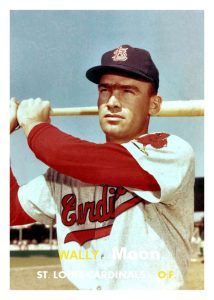 Some years ago, I had the opportunity to obtain an autograph of Wally Moon. Unfortunately, I had nothing in the way of a card or picture worthy of an autograph. So, I hied myself to a local card shop to see what I could find. The price for a 1957 Wally Moon card wasn’t as high as I thought it would be, but there was something odd about it. The uniform didn’t look right.
Before Moon’s moon shots for the Dodgers in the Los Angeles Coliseum made him famous, he was plying his trade with the Cardinals. The picture on his 1957 Cards card was taken the season before and shows a uniform jersey devoid of the iconic (an overused adjective these days but in this case, it definitely applies) birds perched on a bat sprawling across the chest. What gives?
The birds-on-bat design was adopted way back in 1922 when Branch Rickey was a field manager, Rogers Hornsby was in his prime (42 home runs and 152 RBIS in his first .400 season) and Jim Bottomley was a rookie.
Oddly enough, the design’s origin can be traced back to a men’s fellowship meeting at a Presbyterian Church in Ferguson, Missouri in 1921. Allie May Schmidt, a member of the congregation, had been tasked with decorating the meeting hall where Branch Rickey was scheduled to be the guest speaker. As she described it, while gazing out the window she saw two cardinals roosting on a branch and came up with the idea of perching cardboard cutouts of cardinals on sticks as centerpieces on the tables.
Duly impressed, Rickey went to Schmidt’s father, who owned a printing company, and had him design a logo for his team’s uniforms. The intricate birds-on-a-bat design was in sharp contrast to contemporaneous baseball uniforms, which offered little in the way of graphic design. According to a pre-season preview in the April 7, 1923 issue of the St. Louis Post-Dispatch, “It will be by far the gaudiest bit of baseball heraldry that ever dazzled a fan’s eyes.” Then along came the 1975 Houston Astros uniforms, but that is another story. In 1922, the Cardinals’ uniforms were the talk of the league.
Frozen in place much like the objects of a taxidermist’s art in a natural history museum, the birds were on display through many memorable seasons, from the first World Series championship in 1926, through the Gas House Gang days, and into the early years of the Stan Musial era – all in all, nine pennants from 1926 to 1946.
There was, however, a drop-off after that 1946 season – not that the team fell off a cliff. From 1947 through 1949, they finished second, averaging 90 wins per season. After a few seasons of spinning their wheels, the Cards finished in 6th place in 1954 with a 72-82 record. It was the team’s first sub-.500 season since 1938. Then in 1955, they endured a 7th-place finish with a 68-86 record. The .442 winning percentage was the Cards’ lowest since 1924. It was the first time the team had finished as low as 7th since 1919.
Predictably, attendance dropped off to 849,130, the lowest total since the doldrums of the World War II years. Clearly, the team was trending towards the basement – where the Cardinals had not resided since 1918. When Gussie Busch bought the Cardinals in 1953, he didn’t sign up for this. What to do?
Clearly, the team needed shaking up. And one way to do that was to hire a new General Manager. It was a situation designed for a young Turk, but Busch chose to go with a proven success, a 60-year-old, a mature hand…who acted like a young Turk. No one ever had to tell him to shut up and deal.
Much like a player, Frank Lane had worked his way up the ladder in the front offices of minor league franchises. In 1948 the White Sox hired him as General Manager. “Frantic Frank” or “Trader Lane” made 241 deals during his eight-year tenure with the Sox. As Joe Garagiola put it, the guy who had to take the team picture had the toughest job on the club.
In the process, Lane took a team that hadn’t contended since the Black Sox era and made them respectable. Attendance at Comiskey Park eclipsed the 1,000,000 mark from 1950 through 1955. Before 1950 the attendance had never gone beyond six figures. Unfortunately, as good as the Sox got – and they averaged slightly better than 91 victories a year from 1953 through 1955 – it was when the Yankees and the Indians were even better.
So, the Sox plateaued at third place. Still, Lane had rejuvenated a lackluster franchise and major league team owners took notice. Even though Lane had a long-term contract, he got crossways with the Comiskey family and resigned after the 1955 season. So Gussie Busch snapped him up.
Lane wasted little time living up to his “Trader Lane” nickname. In truth, given the Cardinals’ woeful 1955 season, personnel changes were in order, and trades could transform the team faster than waiting for the farm system to come through. Fans were not counting on trading the old Cardinals uniform design for another, however.
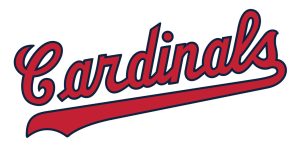 On February 26, 1956, Lane announced, “We hope the new uniforms will match the new, bold look and attitude of the 1956 Cardinals.” By shooing away the perched birds, Lane himself went out on a limb, though he probably didn’t realize it at the time. The new uniforms showcased “Cardinals” in an underscored cursive script. It was a simpler design, but fans weren’t convinced that less is more.
I think I understand why Lane made the change. I’m no clothes horse but I concede that a change of wardrobe does provide a bit of a psychological kick. It’s not up there with buying a new car but it’s the same principle.
Today uniform changes are taken for granted – not just between seasons but during seasons. Alternate uniforms are commonplace but not because fans are demanding them. Many fans do, however, strive to be the first on their block to get new jerseys, T-shirts and caps as soon as they are available. If you have a favorite uniform design that has been superseded, be patient because sooner or later your team will bring it back along with corresponding merchandise.
In 1956, however, souvenir selections were limited. You didn’t need a team shop to showcase the merch. A closet would suffice. So Lane likely made the change not to enhance souvenir revenue but to serve notice that it was a new beginning for the Cardinals. But was it wise to launch a return to glory days while jettisoning a symbol of same? I think not. Neither did fans in St. Louis. So the 1956 uniform style was one and done.
Whatever surprises were in store for Cardinal fans during the 1957 season, the redbirds coming home to roost on the uniforms wasn’t one of them. The 1957 design, however, wasn’t the same as the 1955 version. Notably, the bat, which had been black from 1922 through 1955, was now ash colored. And the birds were perched slightly more upright, but that was all right. Just so long as the birds were back. In truth, there had been changes in the Cardinals uniforms from 1922 to 1955, but no one really cared about alterations to piping, socks, caps or belts. Buttons versus zippers? Who cares?
One could argue that Lane’s change in uniform design wasn’t the most controversial move of his Cardinal tenure. Trading away center-fielder Bill Virdon after his 1955 Rookie of the Year season was a puzzler, even more so in retrospect, as Virdon patrolled the far reaches of Forbes Field through the 1965 season.
Even more outrageous was trading away second baseman Red Schoendienst, an All-Star 9 times in 11 seasons – not a bad deal for him, however, as he got to play in the 1957 and 1958 World Series with the Milwaukee Braves. Even that would have paled in comparison to sending Stan Musial to Philadelphia in exchange for Robin Roberts – which Lane would have done if Gussie Busch hadn’t put the kibosh on the deal. As strange as the 1956 birdless uniform looked on Musial, it wasn’t nearly as outré as the thought of him in Phillies pinstripes.
Even sans the traditional uniform design, the Cardinals improved to 76-78 and a 4th-place finish in 1956. When the jersey birds returned in 1957, the Cards were contenders, at least until they hit a rough patch in August (13-16, their only losing month). They settled for 87-67, good for 2nd place behind the Braves. The Sporting News named Lane Major League Executive of the Year. Nevertheless, Lane butted heads with Gussie Busch and moved on to the Indians.
Described by Robert Creamer as “baseball’s hair shirt, young 60-year-old,” in a Sports Illustrated article, Lane and his itchy trigger finger found expression in Cleveland by trading away matinee idol Rocky Colavito in 1960. In subsequent years the Tribe faithful came to believe that the trade (for Harvey Kuenn) had cursed the franchise. Even worse was trading Norm Cash (acquired in an off-season transaction with the White Sox, he never played for the Indians) to Detroit, where he was a fixture at first base for the next 15 years.
That was more or less the end of Lane’s career as a GM, though he did serve in a similar capacity for the Kansas City Athletics and the Milwaukee Brewers. In his heyday from 1948 through 1960, however, he had courted controversy many times. He never second-guessed himself no matter the results of his trades. His Cardinals uniform gaffe, however, was the exception. He may not have admitted he was wrong; he brought the birds back. Of course, that was one decision that could be reversed easily with no long-term consequences.
Lane the legend lived on long after he departed the Cardinals. Lane the man, however, died on the 19th of March, 1981 at age 86. He was buried at Restland Memorial Park in Dallas (his last gig had been as a scout for the Rangers). Bobby Bragan, a Fort Worth resident, was the only baseball representative. He estimated that only eight people, counting himself, were present. Many of Lane’s trades involved more people than that.
Oddly enough, the 1956 Cardinal uniforms made a brief comeback. On July 2, 2016, 45,477 fans showed up at Busch Stadium for a throwback-themed night in a contest against the Dodgers. Fans not only got to witness a 7-2 loss to the Dodgers, they got to see their team play in a uniform that had been trashed sixty years before.
That a jersey so detested could make a comeback, albeit for a one-night stand, offers hope for many other items of apparel. So rather than clean out your closet, keep those old threads around a little longer. You never know! Nehru jackets might make a comeback.