Lucky Lohrke or Low-Key Lohrke?
March 26, 2026 by Frank Jackson · Leave a Comment
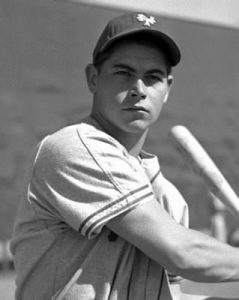
Jack Lohrke played for the New York Giants from 1947-1951
Whenever you read about a disastrous plane crash, there is inevitably a sidebar pertaining to one or more passengers who had reservations but missed the flight for one reason or another. Or there is the occasional passenger who somehow survived the disaster. Last summer, we had the example of a man (Vishwash Kumar Ramesh) who walked away from an Air India crash that killed all the other (241) passengers.
After reading about such events, one cannot help but wonder how one would respond if one were the survivor. The responses of survivors may vary but being blasé is rarely one of them. For most survivors, it is a life-changing event. Some embark on a lifelong guilt trip – I don’t deserve to live…I’m no better than the others. Others may experience an epiphany, a newfound appreciation for life, and might make course corrections in their lives.
Then there are those who might embark on a mission, believing that God, the gods, the Force, fate, or whatever, have tabbed them for a glorious destiny, even though their lives have been humdrum up to that point. This, of course, is the stuff of legend. Think of young Arthur Pendragon pulling the sword out of the stone, or Luke Skywalker evolving from a denizen of a backwater planet into a hero of an interstellar rebellion. Or you might think of real-life figures, such as Sergeant York or Audie Murphy, a couple of provincials who migrated from obscurity to iconic heroism. Then there is the case of Jack Lohrke.
Lorhke was born in 1924, which means he was a prime candidate for the draft during World War II. A semipro player in SoCal, he graduated from high school in South Gate, California, then went on to play minor league ball – but not for long. He spent most of the 1942 season with the Twin Falls Cowboys of the Pioneer League. After being voted team MVP, he got a chance to play in seven games with the San Diego Padres of the Pacific Coast League before he was caught in the draft.
Many ballplayers in the military had light duty. A number of them continued to play baseball for various military teams. Relatively few saw combat. Lohrke was one of them. He was a member of the 35th Infantry Division. He landed at Normandy in June of 1944 and took part in the Battle of the Bulge which began in December of that year. On four occasions he witnessed a soldier next to him get blown away. Also, he survived the crash of a troop train that killed three soldiers and injured dozens.
Of course, many a veteran had horror stories to relate after the war – though many preferred not to. In Lohrke’s case, even after he returned home, the horror continued. On September 15, 1945, he boarded an Army Air Force troop transport plane (specifically, a Douglas C-47 Skytrain, popularly known as a “Gooney Bird”). The plane was hop-scotching east to west from New Jersey to California. When the plane stopped in Ohio, someone pulled rank on Lohrke, and he was bumped from the passenger list. After a stop in Kansas City, the plane crashed after take-off, killing all on board. Rank may have its privileges, but sometimes it’s good to be a peasant.
After his discharge from the army, Lohrke returned to professional baseball in 1946. Playing for the Spokane Indians of the Western International League, he was enjoying a good first half, posting a slash line of .345/.430/.528 as of June 24. The team was on its way to a road game against the Bremerton Bluejackets when a state trooper caught up with the team bus at a restaurant and informed Lohrke he had been promoted to San Diego. So Lohrke bid farewell to his teammates and hitchhiked back to Spokane. Later in the day the team bus went off a cliff near Snoqualmie. Nine of his former teammates, including Lohrke’s two roommates, Freddy Martinez and Bob James, and player-manager Mel Cole, were killed in the crash and subsequent fire. All but one were war veterans. At the time, it was the most deadly accident in pro sports history.
You might wonder what went through Lohrke’s mind upon learning of the tragedy. Born under a lucky star…somebody up there likes me…I must be God’s elect…however you put it. After dodging so many bullets, literally and figuratively, a man couldn’t help but think that he had been singled out for greatness. Small wonder that the alliterative nickname Lucky was attached to him.
Clearly, Lohrke was not traumatized by his latest brush with death. Spending the rest of the 1946 season at San Diego, he posted a slash line of .303/.358/.449 in 92 games. At 22 years old, he appeared ready for the big leagues. The New York Giants thought so and selected him in the Rule 5 draft after the PCL season ended.
Now if we go with the trope of destiny and heroism, it would seem that Lohrke was on a glide path to stardom – maybe even superstardom (though I don’t believe that term was in use in those days). Sort of like Roy Hobbs only younger. But Lohrke didn’t get with the program.
He started 102 games at third base for the Giants in 1947. His fielding average was an unimpressive .939. On the other hand he was a rookie and third basemen usually have lower percentages than their infield compadres – why do you think they call it the hot corner? His slash line was .240/.337/.401. If there was an offensive highlight for Lohrke that season, it occurred on September 1st when he hit his 6th home run of the season off Red Barrett of the Boston Braves. This round-tripper just happened to be the Giants’ 183rd of the season, thus breaking the 1936 major league record set by the Yankees (the Giants’ final total was 221). You might think that was not much of a destiny. But he was 23 years old, still plenty of time to set the baseball world on fire.
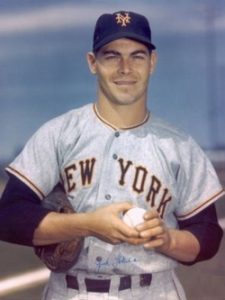 The good news is Lohrke suffered no sophomore slump in his 1948 season with the Giants. The bad news is he wasn’t any better. His offensive performance was pretty much the same (.250/.323/.364) and his defense was worse. As a second baseman (36 games), his fielding percentage was .950. Not exactly Gold Glove caliber. His fielding percentage as a third baseman (50 games) dipped to .898, unacceptable even for the hottest of corners, though maybe deserving of a Fool’s Gold Glove award.
Well, the fulfillment of one’s destiny is rarely without speed bumps. Lohrke wouldn’t be the first budding star who needed more seasoning before rising to Olympian heights. In legends, the hero always must rise above a series of trials to prove he is worthy of his destiny.
So the Giants sent Lohrke across the Hudson River to play for the Jersey City Giants. The results were better. In 347 plate appearances he logged a slash line of .302/.359/.476. His 58 RBIs would have given him 100+ RBIs over a full season. But he didn’t spend the full season at Jersey City. The Giants brought him back. His .267/.333/.456 slash line was enough for him to earn his keep but a long way from stardom. Even so, he was still only 25 years old. A lot of guys were late bloomers. Maybe Lohrke would be one of them.
Unfortunately, for the rest of his career, he was used sparingly, with 47 PAs in 1950 and 51 in ’51. In 1950 he had just 8 hits, all singles. Consequently, his slash line was an embarrassment, showing his batting average and slugging percentage were identical (.186/.255/.186). In 1951 he again had 8 hits but one of them was a home run, resulting in a slash line of .200/.360/.275. I guess you could say the highlight of his season was having a front row seat (actually he was in the right-field bullpen when Bobby Thomson went deep) for the Miracle of Coogan’s Bluff. He did appear twice as a hitless pinch-hitter in the World Series against the Yankees, however. And that loser’s World Series share of $4,951.03 probably looked pretty good to a guy who was making $12,000 a year.
Nevertheless, Lohrke’s career as a New York Giant was over. In December he was traded to the Phillies, in effect transferring him from the 1951 pennant winner to the 1950 pennant winner. Now instead of spending the home half of the season on the bench at the Polo Grounds, he was spending the home half of the season on the bench at Shibe Park. In 1952, again his batting average and slugging percentage were identical (.207/.303/.207) based on six singles.
In 1953 he had two singles, resulting in a slash line of .154/.214/.154), but now he was warming the bench at Connie Mack Stadium, the new name for Shibe Park. Another difference was he spent half the season in the International League as a member of the Baltimore Orioles, a Phillies’ affiliate, then in their last season before the arrival of the major league Orioles. Tellingly, after 190 PAs at the Triple-A level, his slash line was a mere .194/.233/.306.
Lohrke was traded to the Pittsburgh Pirates after the season but never played for them. Consequently, after seven seasons, his final major league slash line was .242/.327/.375. His career fielding percentage as a third baseman was .928. If this was the fulfillment of destiny, it was something of an anticlimax.
The Pirates sent Lohrke to the Hollywood Stars, their PCL affiliate, in 1954. Now here was another opportunity to become a legend. Perhaps his true destiny would be in Hollywood. A talent scout would catch him in action and sign him to a contract. Hey, it happened to Chuck Connors, who was working regularly in movies and TV! And what about Audie Murphy? He had cheated death so many times he once characterized himself as “a fugitive from the law of averages.” In 1955 he played himself in To Hell and Back, a movie based on his book about his World War II experiences.
Lohrke spent two seasons with the Stars but no talent scouts came calling. His stats were better than at Baltimore, but not good enough for the Pirates to recall him. If he was not good enough to play for the Pirates (53-101 in 1954, 60-94 in 1955), then he was not likely to attract interest from any other major league team.
So he languished in the PCL, spending 1956 and 1957 in Seattle, and 1958 in Portland, his playing time diminishing year by year. Some ballplayers with modest or no major league experience go on to become minor league legends, but clearly Lohrke was not one of them. Yet there was a hint of what might have been.
Lohrke had dabbled in pitching in previous seasons, notching six appearances with the Stars in 1954 and 1955. Of course, this could have been late-inning mop-up work to save wear and tear on the bullpen. In 1957, however, Seattle Rainiers manager Lefty O’Doul brought him in for 14 games, which suggests he was not a last resort. His 2.61 ERA in 31 innings is further evidence. At this point he was 33 years old, however, a bit late in the game for a ballplayer to re-invent himself. In 1958 the Portland Beavers were not intrigued by his twirling and limited him to one appearance on the mound. In fact, they weren’t much interested in him period, as he registered just 4 singles in 18 plate appearances. With no BBs or HBPs, he achieved the rare but not desirable distinction of a flatline slash line (.222/.222/.222).
In 1959 his career took an intriguing turn. At 35 years old, he was playing for and managing the Tri-City (Kennewick, Richland, and Pasco, WA) Braves of the Class B Northwest League. His batting average was stuck at .222 but his slash line showed some improvement (.222/.247/.307). He did put himself on the mound for a few games but not enough to get much of a sample size. Nevertheless, by the end of the 1959 season, his minor league career pitching stats showed a 2.35 ERA in 53.1 IP. Did he ever wonder if his baseball destiny was one of those right-church, wrong-pew situations? Had all those years as an infielder been wasted?
Of course, at age 35 in 1959, he could have embarked on a managerial career. Mediocre players who go on to become outstanding managers was not unprecedented. Perhaps that was Lohrke’s true destiny in the game. Or not. After a 60-80 record at Tri-City, his managerial career came to an end.
Fortunately or not, there is life after baseball. In Lohrke’s case, he had another half-century of it. He moved to Northern California and did security work for various Bay Area aircraft facilities (AeroJet General, Lawrence Livermore, and Lockheed). In 1994 he stated “Nobody outside of baseball calls me Lucky Lohrke these days.” True, as a rule, working stiffs are not considered to be blessed with an abundance of good fortune. On the other hand, if you’re fond of alliteration, Lockheed Lohrke might have been a catchy substitute.
Jack Lohrke breathed his last on April 9, 2009, two days after suffering a stroke. Like a Canadian Mountie, the grim reaper always gets his man. Death can be delayed – sometimes for decades – but not denied.
As the media reported his death, Lohrke’s obits dutifully mentioned his close calls with same when he was younger. They did not speculate on his destiny as I have.
Many years after his death dodges, Lohrke remarked, “Having been in combat, what’s going to shock you? I’m a fatalist. I believe the old song, that whatever will be will be.” (He’s referring to “Que Será Será,” which was written for The Man Who Knew Too Much, a 1956 Alfred Hitchcock film. As sung by Doris Day, the film won an Oscar for Best Song and became a hit, appearing as No. 8 on the 1956 top singles list of Billboard magazine.)
In Lohrke’s day there were never more than 400 major league players on active rosters at any time, save for September call-ups, so a case could be made that by playing seven seasons in major league baseball, Lohrke was fulfilling his destiny, even though Cooperstown would never come calling. But did he short-change himself? Was he too chill for his own good?
If Lohrke had felt a sense of mission, would it have inspired his play? Was he held back by his own ennui? Did fate spare him just so he could be a bench-warmer, which is a metaphor for insignificance?
Some brave souls laugh in the face of danger. Lohrke merely shrugged.