


Where Have You Gone, Giuseppe Dimaggio?
April 18, 2026 by Frank Jackson · Leave a Comment
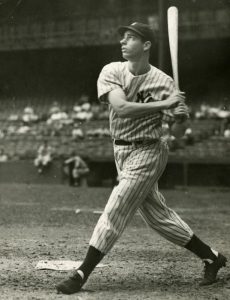 If you could orchestrate your life story, you could hardly improve on the storied career of Joe DiMaggio. A member of the Baseball Hall of Fame (which was not founded till 1939, his fourth season in the big leagues), owner of a record 56-game hitting streak, a New York Yankee who played on ten World Series winners, and the husband of movie stars (Marilyn Monroe) and starlets (his first wife, Dorothy Arnold). People wrote songs about him (“Joltin’ Joe” in 1941), and long after he retired in 1951, Simon and Garfunkel were wondering about his whereabouts in “Mrs. Robinson” (1968). Yet as exalted as Joe D was, his prestige availed his family naught against the “national security” juggernaut.
The December 7th attack on Pearl Harbor might have been shocking, but the December 8th U.S. declaration of war on Japan (for those of you keeping score, this was the last “constitutional” war – i.e., one formally declared by Congress) was hardly surprising. Since Germany and Italy were allies of Japan, it was just a matter of time (in fact, just three days later) before they declared war on the U.S. As a result, President Franklin Roosevelt asked FBI Director J. Edgar Hoover to create a list of people who should be taken into custody due to the national emergency. U.S. Attorney General Francis Biddle and California Attorney General Earl Warren, later Chief Justice of the Supreme Court, were the top law dogs in this effort.
In February 1942, Joe DiMaggio headed for Florida. The Yankees had held spring training in St. Petersburg, Florida since 1924, but that was not where he was headed, at least not initially. He figured a few weeks of fishing and relaxing in Florida was a good way to pass the remainder of the off-season and wait out his contract impasse.
1941 had been the most memorable season to that point in his career, as it included not only his 56-game hitting streak but also another World Series championship and his second MVP award. For good measure, he led the league in RBIs (125) and total bases (348). His WAR of 9.3 was the highest of his career, though that statistic didn’t exist in those days. FUN FACT: In his .406 season of 1941, Ted Williams led the league in WAR with 10.4, yet it was not his best mark. He registered 10.5 in 1942 and 10.6 in 1946.
DiMaggio should have had that top-of-the-world feeling as he planned for the 1942 season, but Pearl Harbor had changed everything. Offering the war as an excuse, Yankee GM Ed Barrow had offered Joe a contract for the same pay he had received in 1941. How could Joe object to another year earning $37,500 while other men his age were giving up jobs to serve their country for soldier’s pay? Considering how many extra fans had come out to Yankee Stadium and other American League ballparks in 1941 to see him prolong his hitting streak, he had made plenty of money for his bosses and should have been rewarded for it. War or no war, that was his attitude.
Joe had no immediate worries about the draft (he was classified 3-A, since he was a married man with a child, namely, Joe DiMaggio, Jr., born on October 23, 1941), but he might have wondered about his brothers. Older brother Vince, then with the Pirates, enjoyed his best season (21 HRs, 100 RBIs) in 1941, yet he had been rated 4-F due to a stomach ulcer. Younger brother Dom of the Red Sox, an All-Star in his sophomore season, had been classified 4-F due to poor eyesight (though after the 1942 season, he was able to enlist in the Navy). Joe probably gave no thought as to how the war would affect his elderly father Giuseppe, since he was way past draft age. Unfortunately, Uncle Sam had other plans.
While Joe was taking it easy in Florida, FDR issued Executive Order 9066 on February 19, 1942. He would go on to issue 290 EOs in 1942 (and 2,023 during his 12+ years in office).
They don’t teach civics in schools anymore, so some readers might find it hard to believe that executive orders were never intended to bypass legislation but to facilitate the logistics of enforcing legislation. The legal justification given for EO 9066 was Title 50 of the U.S. Code, popularly known as the Alien and Sedition Acts passed in 1798. Of the four laws that comprised the Acts, only one, the Alien Enemies Act, was still in effect in 1942 – and it remains so today. In fact, President Trump has cited it as a cornerstone of his policy for deporting illegal aliens and combating Mexican drug cartels.
The Alien and Sedition Acts were controversial in 1798, long before civil rights was a big deal. For a nation conceived in liberty just a few years before (the Constitution became the law of the land in 1788), it seemed an abrupt about-face. Curiously, the Alien and Sedition Acts were not in response to a war but a potential war with France. Volumes have been written about the Acts (famously, President John Adams was an advocate, Vice-President Thomas Jefferson was an opponent), and the effects of EO 9066 on Japanese Americans during World War II has received a great deal of attention. Yet the order also applied to large numbers of Italians and Germans living in America. Of the former, there were roughly 5,000,000 in America in 1942. 600,000 were not citizens and were forced to register as enemy aliens. Giuseppe and Rosalie DiMaggio, Joe’s parents, were among them.
While roughly 120,000 Japanese were interned under EO 9066, relatively few Italians (hundreds, not thousands) were sent to internment centers, but many found their lives had taken a turn for the worse after the entire West Coast was declared a military exclusion area. Subject to a curfew from 8 PM to 6 AM, they had to always carry photo ID booklets and were forced to surrender flashlights, shortwave radios, guns, binoculars, and cameras which could potentially be used for espionage. For the same reason, approximately 10,000 Italians were relocated away from power plants, dams, and military facilities. They could not travel more than five miles from home without a permit. The Pacific coast was no longer pacific.
Unfortunately, if one’s home happened to be close to the coastline, then relocation was a must. While EO 9066 affected resident alien Italians from all walks of life, one occupation hit particularly hard was commercial fishermen, almost all of whom lived close to the water. Even if they moved inland, they could no longer ply their trade, since they were not allowed near the waterfront. Giuseppe DiMaggio, a lifelong angler, was caught up in the West Coast dragnet.
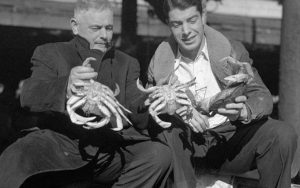
Giuseppe (left) and Joe
Giuseppe had a lot of company. Some 10,000 Italians had to move out of restricted areas along the coast. San Francisco’s North Beach area with its sizable “Little Italy” neighborhood, was particularly affected (as was San Diego, which had its own “Little Italy”). Adding insult to injury, Uncle Sam impounded Giuseppe’s boat. Yet another irritant was that Giuseppe could not visit DiMaggio’s Grotto, Joe’s restaurant on Fisherman’s Wharf. Giuseppe enjoyed hanging out at the restaurant and cooking up his special dishes but even that simple pleasure was denied him.
While enduring all this misfortune, he might have been having second thoughts about not applying for citizenship. He had been in the U.S. for more than four decades. Yet he was luckier than most because he could lean on three sons who were major league ballplayers as well as American citizens.
Giuseppe DiMaggio left Sicily and arrived in northern California in 1898. His wife Rosalie followed several years later. Originally settling in the waterfront town of Martinez (on San Pablo Bay), they moved to the North Beach area of San Franciso soon after Joe was born. Since Giuseppe was a fisherman (roughly 80% of the fishermen in California were Italian), living on the coast was a given.
Despite their long residency in the U.S., Giuseppe and Rosalie had never applied for citizenship. Perhaps they never got around to it, or maybe they thought they would retire to the old country one day. Or it might have been that their English wasn’t very good and they figured they wouldn’t pass the test. For whatever reason, their failure to become US citizens put them in the crosshairs of EO 9066.
One might think that such rude treatment of the parents of arguably the best baseball player of his era was bad public relations. Throw in Dom and Vince and it could be said that baseball fans owed a great debt to Giuseppe and Rosalie. General John DeWitt, part of the top brass in the West Defense Command, thought otherwise. He felt it was important to make an example of them. After all, if Uncle Sam made no exceptions for Joe DiMaggio’s parents, then it would be clear to everyone affected that the administration was giving out no hall passes.
Of course, the feds knew that not every non-citizen was a spy, and that U.S. citizenship was no guarantee that a person was not a spy. But building a dossier on individuals to obtain warrants would be labor-intensive and time-consuming, and while that was ongoing, any number of saboteurs could go about their business. The feds had records showing who was a citizen and who wasn’t. It was easier to shut down all the non-citizens from Italy and vet them afterwards rather than take the time to ferret out disloyal individuals before detaining anyone. The potential for political fallout was virtually nil. Few American citizens objected and the non-citizens couldn’t express their outrage at the ballot box because they were not eligible to vote.
In fairness, it must be remembered that while Italian fishermen loomed large in San Diego and San Francisco, they were not the biggest players in those towns. Naval Base San Diego was a major facility. In San Francisco the Navy had a shipyard in Hunters Point (where the Giants would open Candlestick Park in 1960) in the southeast corner of the city. Obviously, it would be relatively easy for an enemy agent in San Diego or San Francisco to keep track of arrivals and departures, passing on information that could potentially affect the war in the Pacific Theater. A fisherman could be just that, or he could be a spy. A fishing boat could be just that, or it could be a spy ship. Once war is declared, things change overnight. It didn’t start with World War II. Plenty of questionable detentions took place during the Civil War and World War I.
A resident alien who was eligible to become a citizen but chose not to raised eyebrows, particularly during wartime. Perhaps the best example is British émigré Charlie Chaplin, who came to the USA at age 19. Four decades later, he had never applied for US citizenship. He was one of the most famous people in the world, yet he became persona non grata in the USA during the Cold War and was prevented from returning to the country after a European trip. If Chaplin could be put through the wringer, lesser mortals didn’t have a chance.
Given the indignities the US government had inflicted on them, it is perhaps surprising that the DiMaggios eventually became citizens, Rosalie in 1945 and Giuseppe in 1946. They did not enjoy the fruits of citizenship for long, however. Giuseppe died in 1949; Rosalie followed him two years later.
In 1999, Congress figured it was time to apologize to Italian Americans. So H.R. 2422, or the Wartime Violation of Italian American Civil Liberties Act, was introduced. In other words, politicians who were not in Congress in 1942 (and most of whom were born after 1942) apologized for something they had nothing to do with, sort of mea culpa by osmosis. Rather than pay it forward, Congress paid it backward. The opportunities for virtue signaling were abundant, and the rhetoric flowed accordingly.
A number of witnesses were brought forth to testify as to the effects of the wartime restrictions. Among them was 82-year-old Dom DiMaggio, the last of the big league DiMaggios (Joe had died earlier in the year and Vince had passed away in 1986). Like the other speakers, he urged passing H.R. 2422, the main purpose of which was to dig deep to find out how such a thing could have happened and to ensure it would never happen again. Call it the old truth and reconciliation soft-shoe.
It’s been more than a quarter of a century since Dom DiMaggio’s testimony; since then, more apologies for other bad government policies have followed. Such inquests always evoke that time-honored passive-voice phrase, “mistakes were made.” Given the popularity of retro guilt trips in the rear-view mirror, I guess we could say that such mistakes are closer than they appear.


