


Nobody Expects the Unassisted Triple Play
June 5, 2026 by Frank Jackson · Leave a Comment
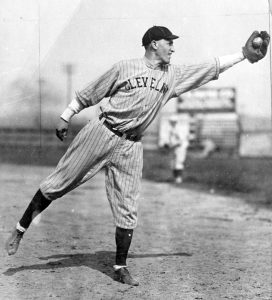
Cleveland second baseman Bill Wambsganss
According to Baseball Almanac, there have been 740 triple plays in baseball history from 1876 through 2025. That’s an average of 4.93 (let’s round that off to 5) per year, or less than once a month. There are 2,430 MLB regular season games played each year, or roughly 405 per month. So, no matter how you slice it, your chances of seeing a triple play are slim, which is why statisticians don’t bother to keep GTP (grounded into triple play) statistics.
As for the unassisted triple play…well, you could be a season ticketholder for a lifetime and never witness one. Or you could be a casual fan and see one on your first trip to a ballpark. No matter how many times one witnesses a situation with no outs and two or three men on base, nobody expects the unassisted triple play.
The most famous unassisted triple play (henceforth let’s use a UTP acronym to save space) is credited to Cleveland second baseman Bill Wambsganss in the 1920 World Series against the Dodgers. Of course, anything achieved during the World Series is magnified, but it helps to illustrate how rare the achievement is. Aside from Wambsganss, only 14 players have pulled it off during regular season games since 1876. That averages out to once a decade.
The first UTP wasn’t recorded till 1909 (shortstop Neal Ball of Cleveland). Against all odds, there were two in 1923. Even more unlikely, both occurred in Boston in the closing weeks of the season. Nobody expects to see two UTPs in the same city in the same season. Yet first baseman George Burms did the deed for the Red Sox on September 14, and shortstop Ernie Padgett did it for the Braves in the second game of a double-header on the last day of the 1923 season (October 6), just three days after making his major league debut.
Of course, no baseball fan expects to witness two UTPs within a five-week span, yet it is entirely possible that a few baseball fans in Boston witnessed both of those 1923 UTPs. If so, it was surely a precious few, as the attendance at the former game (the Red Sox would finish the season in last place) was estimated at 2,500, and on the latter date a mere 1,000. This sum was hardly surprising since the seventh-place Braves had already lost 100 games and were taking on the last-place Phillies. Due to the chilly weather, probably only a hearty few remained to witness Padgett’s web gem, as it occurred in the fourth inning of the second game, which had been shortened to five innings thanks to a pre-game agreement after the first game lasted 14 innings.
I think it’s also safe to say that nobody expects UTPs to occur on consecutive days. Yet against almost incalculable odds, it happened (achieved by shortstop Jimmy Cooney of the Cubs and first baseman Johnny Neun of the Tigers) on May 30 and 31, 1927. Oddly enough, Cooney had been on base when Pirates shortstop Glenn Wright pulled off a UTP in 1925.
After Johnny Neun’s UTP there was a long drought till shortstop Ron Hansen did the deed for the White Sox in 1968. Notably there was one per season from 2007 through 2009 (shortstop Troy Tulowitzi of the Rockies, second baseman Asdrúbal Cabrera of the Indians, and second baseman Eric Bruntlett of the Phillies), but just when it looked like it had become an annual tradition, bupkis. Now nobody expects an annual unassisted triple play.
(Just for the record, the four unassisted triple plays not mentioned above were the handiwork of Phillies second baseman Mickey Morandini in 1992, Red Sox shortstop John Valentin in 1994, A’s second baseman Randy Velarde in 2000, and Braves shortstop Rafael Furcal in 2003).
Given the number of minor league leagues and teams, it stands to reason that various individuals on various teams in various leagues have turned UTPs over the years. Of course, even in the minor leagues nobody expects a UTP. And even if one occurs, minor league ball does not get major media attention, so an unknown number of UTPs have gone down the memory hole. Some achievements, however, are so rare that attention must be paid no matter how obscure the league or the player.
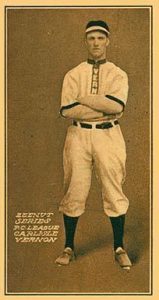
Walter Carlisle
You’ve probably never heard of Walter Carlisle. Since his major league career was limited to three games with the Red Sox in 1908, that is understandable. His minor league career, however, lasted 18 seasons during which the British-born Carlisle accrued 2,237 hits. The Sporting News reported that the diminutive (5’9”, 154 pounds) outfielder had been a circus acrobat, though whether that was before he turned pro at age 20 or during the off-season was left unaddressed.
Carlisle kicked off his career in Minnesota, playing for both the Crookston Crooks of the Western League and the Minneapolis Millers of the American Association. After toiling in the low minors for several seasons, he worked his way up to the Pacific Coast League in 1906. Of the ten seasons he spent in that league, 1911 was probably his best. As the regular center fielder for the Vernon Tigers, he amassed 239 hits, which is not quite as impressive as it sounds, since the PCL played a lengthy schedule. Carlisle played 206 games and had 805 at bats that year, but he also hit 17 home runs, a career high and a pretty impressive total for the deadball era. All well and good, but for sure the highlight of his season occurred on July 11.
Carlisle was playing a shallow center field since the batter, Roy Akin of the Los Angeles Angels, rarely got more than a one-base knock. With runners on first and second, Akin hit a blooper to center. Carlisle charged in and made a diving catch (given Carlisle’s alleged background, the term “circus catch” is particularly apt), sprang up, stepped on second base to double off the lead runner, Charlie Moore, and tagged the other runner, George Metzger, before he could return to first. Carlisle’s unassisted triple play remains the one and only ever achieved by an outfielder in pro ball. Consequently, it was the one and only time in organized baseball history when TP 8U was inscribed on a scorecard. If I were Carlisle, I would have had requested that as a personalized license plate, though that probably wasn’t an option in 1911.
At this point in the narrative, we bid farewell to Carlisle (his minor league career continued through 1923), who died of a heart attack at age 63 in 1945. We are not through with Roy Akin, however. Of course, hitting into a UTP is as rare as a fielder achieving one. It just isn’t as much fun. In fact, if you are a batter, it is the ultimate fustercluck. What makes Akin unique is he did both.
Like Carlisle, Akin enjoyed a long minor league career starting at age 20. He started out with the Texas League (Class D) in 1902, splitting the season between the Dallas Griffins/Steers and the Paris Parisians/Frenchmen/Frog Eaters. Obviously, nicknames were more fluid (and often more colorful) in those days, and most of them did not appear on uniforms but were coined by sportswriters. In the latter half of the season, the Paris team was known as Eisenfelder’s Homeseekers. This polysyllabic moniker derived from team owner C.W. Eisenfelder, who was so upset by the dearth of fans in Paris during the early going that he shifted many of the team’s home games to away games, which were less of a drain on his resources.
Unlike Carlisle, Akin never made it to the major leagues, not even for a cup of instant coffee. The closest he got was a tryout with the Boston Red Sox. There were career highlights, however. In 1906 he was the starting third baseman for the champion Cleburne Railroaders in the one and only year that town had a franchise in the Texas League. Another claim to fame occurred in 1908 when, as a member of the Houston Buffalos, he and his teammates found an abandoned baby on a train during a road trip, and he and his wife ended up adopting it.
In 1911, when Akin hit that fatal blooper to Carlisle, he was at the highest minor league level (the Pacific Coast League) of his career. His season, however, was largely forgettable (.244 BA and a slugging percentage of just .278). The Angels were also experiencing a largely forgettable season. They finished in last place (which meant sixth in 1911), winning just 82 games, which doesn’t sound too bad, but thanks to that extended PCL schedule, they lost 127 games, finishing 39.5 games behind the pennant-winning Portland Beavers. Perhaps even worse, they finished 37.5 games behind Walter Carlisle and the second-place Vernon Tigers (118-88), their crosstown rivals. Arguably, the most memorable moment of Akin’s season was when he hit into that UTP.
Obviously, the Angels needed to make some wholesale changes before the 1912 season, so Akin was expendable. In 1912 Akin found himself back in the Texas League (elevated to Class B by that time) with the Waco Navigators. The Navs finished in third place with a record of 82-63. Akin hit .272 with a .353 slugging percentage (27 doubles, 6 triples, and 1 home run), which was not bad for him. But the highlight of his season occurred while he was in the field at his customary position, third base.
On May 9, 1912, Akin and the Navs hit the road to play the eventual league champions, the Houston Buffalos. In the first inning the Buffs had John Fillman (also the manager) on third and Gilbert Britton on second with nobody out. Fillman had been known to favor bunting in such a situation, so Akin was ready at third base. The runners were on the move when Red Davis lined a bunt toward Akin, who was in the right place at the right time. He speared the line drive near the third base bag. Fillman, of course, was an easy out once Akin stepped on third base. The speedy Britton, however, had also passed third base. So, he was also retired as soon as Akin stepped on the base. It was a suicide squeeze plus a double homicide. So Akin had hit into one UTP and scored one in the field. What are the odds? Nobody expects to be both a victim and a beneficiary of a UTP.
Akin was almost 30 years old when he pulled off his UTP. His playing career would be over after two more seasons in the Texas League. He split the 1913 season with the Houston Buffalos and the Fort Worth Panthers, then returned to Waco in 1914. The Navigators finished at 102-50, which put them at the top of the league, tied with Houston. Akin probably figured that was the best team he had played on or ever would play on, so he retired as a player, aside from a few at bats in 1922 when he managed the Mexia Gushers of the Texas Oklahoma League.
Aside from managing, Akin remained in the game in other capacities. He worked as an umpire, coached the Trinity University (San Antonio) baseball team, and spent a couple of years as a scout for the Galveston Texas League team. Away from the game, he was a cotton buyer.
He was in fine health during the first five decades of his life, but he didn’t make it beyond age 51. Nobody expects a ruptured appendix. Akin, of all people, should have learned to expect the unexpected.


