Wowie Howie!
November 22, 2026 by Frank Jackson · Leave a Comment
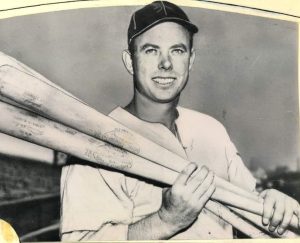
Howie Moss
Every now and then, one ponders why a stellar minor league player fails to cut it at the major league level. And every now and then one ponders why a minor league city – often larger than many major league cities – hasn’t gone MLB. And every now and then such a player is on the roster of such a team. Consider the case of Howie Moss, a mainstay of the International League Baltimore Orioles in the 1940s.
Howard Glenn Moss, a native of Gastonia, North Carolina, held a key role on an American Legion team (Gastonia Post 23) that won a national tournament, defeating a Sacramento squad in the 1935 finals. Moss was one of two players who went on to the major leagues. The other was Lawrence Columbus “Crash” Davis. This wasn’t the Kevin Costner character in Bull Durham. Director Ron Shelton borrowed the name – with the permission of the character’s namesake, who was not a catcher but a middle infielder, though he did have links to Durham, having played college ball at Duke and one season (1948) with the Durham Bulls of the Carolina League.
Davis played three seasons of major league ball starting in 1940, but his career slash line of .230/.289/.279 was hardly encouraging, even by the standards of his team, the Philadelphia A’s, who had a collective record of 173-289 during his tenure. After military service in World War II, he spent the rest of his baseball career in the minor leagues before returning to Gastonia to coach high school and American Legion ball. FUN FACT: When Ron Shelton made Cobb (with Tommy Lee Jones in the title role) in 1994, he cast Davis as “Wahoo” Sam Crawford.
Davis’s last year in MLB was the first year of Howie Moss’s MLB career. While Davis had chosen to play college ball, Moss went straight to pro ball. At age 17, he signed with the New York Giants and made his debut in 1936 with Greenwood (SC) of the Class C Cotton States League. His slash line of .233/.267/.309 could charitably be described as inauspicious. Moss’s youth notwithstanding, his season did not indicate much of a future as a professional baseball player. Yet he persevered, both in the low minors and in Cuba. In 1941 at age 22 he finally had a breakthrough year with a .346 batting average and 24 home runs with the Fort Smith Giants of the Western Association. In 1942 he was bumped up to the Columbus (OH) Red Birds and eventually to the big-league Giants for a decaffeinated cup of coffee: a slash line of .000/.000/.000 based on 0 for 14.
Though big league standards were relaxed in 1943 due to the military draft, Moss’s record was not good enough to secure him a roster spot with the Giants, but he remained in metro New York, playing for the Jersey City Giants of the International League. He did not distinguish himself there with a slash line of .233/.275/.324.
A change of scenery often makes a difference, and it came to pass that everything came together for Moss with the Baltimore Orioles, a Cleveland Indians affiliate in 1944. Playing in the International League, as he had in 1943, his slash line improved to .306/.370/.549. He led the league in total bases (319), hits (178), home runs (27) and RBIs (141). That sounds like an MVP season, and indeed it was.
Moss was a key reason the Orioles (a lackluster 73-81 in 1943) won the Governor’s Cup (the International League championship) in 1944, defeating the Buffalo Bisons in the first round of the playoffs and the Newark Bears in the finals. For good measure, they defeated the Louisville Colonels (the American Association champion), in the Junior World Series.
The Orioles set a franchise attendance record with 342,032, particularly impressive since it occurred during a World War II season when a number of minor leagues had suspended play. That total was surely enhanced by the Orioles moving to Memorial Stadium which had a larger seating capacity than Oriole Park, their longtime home (built in 1914 to house the Baltimore Terrapins of the Federal League), which was destroyed in a mid-season fire.
Notably, in the fourth game of the Junior World Series, the Orioles drew a crowd of 52,833, another minor league record. By contrast, that same day, the sixth game of the all-St. Louis MLB World Series, drew 31,630.
After spending the 1945 season in the military and helping the Bainbridge (MD) Naval Training Center win a baseball championship, Moss got yet another cup of coffee in 1946 with the Cincinnati Reds, who had obtained him in the Rule 5 draft. Thanks to a leg inijury and a bout of pneumonia, this cup of coffee was weak though not entirely decaffeinated (.192/.192/.222).
Moss was returned to the Indians, who sent him back to Baltimore, and he picked up where he left off. Moss led the league in homers (38) while the Orioles drew 620,726 for the season, shattering the record set just two years before. Part of this was residual enthusiasm from the 1944 glory year but a lot of it was due to the post-war attendance boom that affected all teams, major and minor. The Orioles outdrew the major league Browns (526,435) and almost matched the A’s (621,793). Despite the presence of Moss, Eddie Robinson, and Sherm Lollar, the Orioles lost to Syracuse in the playoffs. Another familiar name on the Orioles roster was outfielder Jim Honochick, who went on to a lengthy (1949-1973) career as an American League umpire. His career slash line (.277/.371/.392) was not terrible, but he was 28 years old in 1946, so a career change was in order.
Perhaps thinking the third time was the charm, the Indians brought Moss back for yet another audition at the end of the 1946 season. Unfortunately, this was yet another unimpressive sojourn, 2 singles in 32 at bats (.063/.063/.205). This concluded his major league career. Despite his well-deserved reputation as a slugger (263 minor league home runs), he never got an extra base hit in the big leagues. Befitting a slugger, however, he struck out 17 times in 72 at bats.
In 1947 at age 28, Moss was back in Baltimore and kept up the good work, leading the league in total bases (325) and home runs (53). He followed up in 1948 with another league-leading total of 33 home runs. He was the only player in International League history to lead the league in home runs four times. But 1948 was also the year Bill Veeck’s Indians won the World Series (their last title to date). They led the league in batting average (.282), hits (1,534), and home runs (155) so there was no reason for them to take another flyer on Moss.
At age 30 Moss was an 11-year veteran of minor league ball. Time to think about a career change? Nope, in 1949 Moss remained in Triple-A ball, shifting to the Milwaukee Brewers, a Boston Red Sox affiliate in the American Association. Again, he put up good numbers, .294/.370/.510 with 29 home runs and 117 RBIs. The Brewers advanced to the league finals but lost to the Indianapolis Indians.
If Moss was hoping to get a shot with the Red Sox, he was in no better position thatn he was in Baltimore. The Red Sox were coming off a 96-59 record in 1948 and would post a 96-58 record in 1949. In the latter year they led the league in hitting (.282), hits (1,500), home runs (131), slugging (.420), OBP (.381), walks (835), and runs (896). Like the ’48 Indians, they had no need to call up any offensive help from the minors.
Moss put up decent numbers in 1950 but fell off a bit in 1951, starting with the Brewers and finishing with the Orioles (now affiliated with the Phillies). 1951 was not a total loss, however, as he began an off-season career as a car salesman in Baltimore, where he was something of a local celebrity.
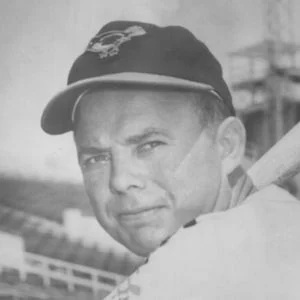 Things got worse in 1952 when he was demoted to Class A ball (Augusta of the Sally League and St. Petersburg of the Florida International League) and finally to Class B (Gastonia of the Tri-State League), which at least gave him the opportunity to finish his pro career in his hometown. He went out in style there with a .314/.411/.527 slash line to go with 9 home runs and 41 RBIs in 169 at bats until his season ended with a broken toe.
Since Moss had established himself as a car salesman in Baltimore, he had a home and a profession after baseball. He never made the Show, but he was in Baltimore when the Show got there in 1954. In 1960 he was inducted into the International League Hall of Fame based on his salad days withi the Orioles. He died in Baltimore in 1989 and was buried in suburban Timonium.
You might wonder what keeps guys like Moss going. At some point they realize they are not going to be major leaguers, yet they persevere in the minors. Why? I suppose the reasons vary from player to player, but in Moss’s case, I think there was a unique motivation: his nickname of Howitzer Howie.
In my book, that alone would make it all worthwhile.