


Who, You Ask, is George Sisler?
October 29, 2008 by Mike Lynch · 9 Comments
I’m currently finishing up my second book, “It Ain’t So: An Alternative History of the Chicago Black Sox,” but I’d like to contribute something to the site, so here’s an article I wrote about Browns first baseman George Sisler last year.
He is probably the only player other than Gehrig who can reasonably be considered the greatest first baseman ever in terms of peak value. The reason I say that is that the other top contenders, most notably (Jimmie) Foxx and (Willie) McCovey, were the same type of players that Gehrig was, and thus they can be directly compared to him, a comparison that they clearly lose. But the man I’m referring to was a different type of player, he didn’t have the home run pop, but he hit for a higher average, was faster and a better defensive player than Gehrig, and the comparison between the two is not easy. – Bill James, The Historical Baseball Abstract.
Who, you ask, was this great first baseman?
George Sisler was a star pitcher at Central High School in Akron, Ohio when he signed his first professional contract in 1911 at the age of 17, inking a deal with the hometown Akron club of the Class C Ohio-Pennsylvania League. Because he was a minor and had failed to garner his parents’ consent, Sisler and his father requested that the contract be declared invalid. Sisler then enrolled at the University of Michigan and began playing ball for the Wolverines, who were coached by Branch Rickey. In September 1911, Akron sold Sisler’s contract to Columbus of the American Association, assuming they still held his rights. In March 1912, Columbus demanded that Sisler report to spring training, but he refused on the grounds that he was still a minor, that he was attending college, and that his parents still wouldn’t consent.
Just as Akron had before it, Columbus placed Sisler on its ineligible list and allowed him to continue his college career. Columbus sold Sisler’s contract to Pittsburgh in August 1912 for $5,000 and on September 1, the National Commission approved the deal. As far as Pittsburgh owner Barney Dreyfuss was concerned Sisler was a Pirate.
The Pirates demanded that Sisler join the team after high school graduation but Sisler had other plans, heading to Michigan instead, where he began dominating collegiate batters with his left arm. “The workout was unforgettable,†Rickey remembered about Sisler’s first appearance against the Wolverines’ varsity squad. “He pitched batting practice and, for the next 20 minutes, created no end of varsity embarrassment. His speed and control made him unhittable. All his moves were guided by perfection of reflexes, which made him quick, graceful, accurate—the foundation of athletic greatness. It was all there.â€
 As a freshman George Sisler once fanned 20 batters in seven innings during a University of Michigan intrasquad game
Pittsburgh appealed to the National Commission, baseball’s ruling body at the time, but to no avail. The Commission eventually ruled that Sisler’s contract was null and void because at 17-years-old he was legally too young to have signed a contract without his parents’ consent and declared the young pitcher a free agent. The future first baseman signed with the St. Louis Browns, who had hired Rickey to manage the team, and joined them in June of 1915 after three successful seasons with the Wolverines.
(For more about the Sisler Case, click HERE).
Sisler’s first appearance came in Chicago against the White Sox, where he threw three scoreless innings, allowing only one hit in his Major League debut. About his debut James Crusinberry wrote in the Chicago Tribune:
“Later [Parson] Perryman retired, and allowed George Sissler [sic], the star of the University of Michigan ball team, to make his professional debut. Young Sissler [sic] has just been graduated and began battling the world yesterday. To all indications he will have it conquered before long, for the collegian had the appearance of being made of real baseball stuff.
Young Sissler [sic] was a pitcher, and outfielder, or an infielder while at the university and had the reputation of being the best college player in captivity. It was nothing for him to make four base hits and steal three or four bases during a game. He often held other college teams to a hit or two for nine innings. He pitched only three innings against the Sox and allowed only two hits, one a two bagger by Eddie Collins and the other an infield single by Schalk.â€
Rickey continued to use Sisler as he had when they were at Michigan and had the young star bouncing back and forth between first base and the outfield, earning a start on the hill every now and then. The final numbers had Sisler playing 37 games at first base, 29 in the outfield and only 15 in the pitcher’s box, ushering in an end to his pitching career before it had a chance to get off the ground. He went 4-4 with a nifty 2.83 ERA in 70 innings and didn’t allow a single home run to the 293 batters he faced. He also batted .285 with three home runs and 29 RBIs and he stole 10 bases in 19 attempts. He struck out 27 times and drew only seven walks, but that would be the only time in his 15 seasons in the majors that he would fan more than he walked.
Sisler started three games on the mound in 1916 and allowed only three runs in 27 innings for a 1.00 ERA, but his greatest achievement would come at the plate, where he hit .305 with 34 stolen bases, and in the field, where he led the league in total chances per game.
1917 through 1919 would see the Browns’ first sacker come into his own as a hitter, while maintaining his excellence in the field. His .353 average in 1917 was second in the American League only to the great Ty Cobb, who won his 10th batting crown that season, outdistancing Sisler by 30 points. Sisler added 30 doubles, nine triples and 37 stolen bases to his resume, while striking out only 19 times in 539 at bats. In the field he recorded 97 double plays, tying New York’s Wally Pipp for league honors.
In 1918 Sisler finished third in the batting race behind Cobb and Philadelphia’s George Burns, while hitting .341. He did win his first stolen base crown, however, pilfering 45 and outdistancing Cleveland’s Braggo Roth by 10. Boston’s Stuffy McInnis was the American League’s top first baseman that year but Sisler wasn’t far behind, establishing a career low in errors with only 13.
To this point, the Browns’ star player wasn’t displaying the power of Cobb, Tris Speaker, or Gavvy Cravath, but he was among the top power threats in baseball and was fourth in the American League in slugging from 1915 to 1918 (among batters with at least 2,000 plate appearances). Low home run totals weren’t uncommon before 1920 when many rules changes took affect and a new, supposedly livelier ball was introduced. Sisler didn’t wait until 1920, though, to show what he was capable of doing in the power department. 1919 saw him smack 10 homers to go with career highs in doubles and triples, as he lashed out 31 and 15, respectively. He also posted career highs in runs (96), RBIs (83) and slugging (.530), while falling only one point short of his career best .353 batting average of 1917. Again, he finished third in the batting race, falling to a pair of Detroit Tigers—Ty Cobb, who would win his twelfth and final title, and Bobby Veach, who edged Sisler .355 to .352 for second place. In the field, Sisler led all American League first basemen in assists, one of seven times he would accomplish the feat.
 Sisler batted .407 in 1920 and set a record for hits in a single season (257) that stood until 2004
1920 would find Sisler standing alone atop the baseball world as he put together one of the finest single-season performances in baseball history. Like many others, Sisler took advantage of the spitball ban, enacted in the winter of 1919, and the new practice of keeping fresh balls in play to enhance his reputation as a hitter. He played every inning of all 154 games, amassing a league-high 631 at bats, in which he rapped out 257 hits—a major league record that stood for 84 years before Seattle’s Ichiro Suzuki broke it in 2004—giving him a league-leading .407 batting average and his first batting crown. He smashed 49 doubles, 18 triples and 19 homers—all career highs—and established career marks with 137 runs scored, 122 RBIs, 46 walks and a .632 slugging percentage. His masterful performance carried over onto the field as he led all first basemen with 140 assists—the fourth highest single-season total to that point. This, combined with the retirement of “Prince†Hal Chase, earned Sisler the title of best glove man around the first base bag.
The slick-fielding first baseman relinquished his batting Crown to Detroit’s Harry Heilmann in 1921, despite posting a .371 average— good for fourth behind Cobb and Babe Ruth—and lacing 200 hits for the second year in a row. But he won his second stolen base title, swiping 35 and edging Washington’s Bucky Harris, who stole 29, and scored and knocked in over 100 runs for the second consecutive season. Sisler established career bests with a .993 fielding percentage, while committing only 10 errors, but Boston’s Stuffy McInnis had perhaps the greatest season any first baseman has ever known, setting an all-time record with a .999 percentage, while committing only one miscue all season.
“Gorgeous George†enjoyed a 1922 season that may have been even better than his 1920 campaign. He led the league with 246 hits—his third consecutive 200 hit season—18 triples, 134 runs scored, 51 stolen bases and an amazing .420 batting average, all while striking out a miniscule 14 times in 586 at bats. Sisler finally got his revenge over Cobb, besting him for the batting title despite Cobb’s .401 mark. Only one other time in history had a batter finished with an average over .400 and not won a batting crown—1911 when Cobb’s .420 mark edged “Shoeless†Joe Jackson’s .408. This time the Tigers great was on the other side of the fence. Only Nap Lajoie’s .422 average in 1901 and Cobb’s .420 in 1911 is equal to or better than Sisler’s .420 in 1922 in American League history (Sisler’s .41979 is actually higher than Cobb’s .41962).
And only Cobb, National League great Rogers Hornsby and Sisler hit .400 or better more than once. During the season, Sisler fashioned an American League record 41-game hitting streak that would stand until Joe DiMaggio shattered it in 1941, despite suffering from a severe shoulder injury. As if that wasn’t enough, the Browns’ first sacker also led A.L. first basemen is assists for the third time with 125.
1922 also saw the Browns compete for a pennant for the first time since Sisler arrived in 1915. St. Louis finished in second place, only one game behind the Yankees with a 93-61 record. Outfielder Ken Williams wrested the homer crown from Babe Ruth, pacing the league with 39 circuit clouts, while driving in a league-leading 155 runs. Second baseman Marty McManus chipped in a .312 average and 109 RBIs and outfielder Baby Doll Jacobson contributed a .317 average and 102 RBIs, making the Browns the first team in history to have four 100-RBI men, but it wasn’t enough to earn them their first pennant.
“He single-handedly led us down to the wire in the pennant race that year,†Rickey said about Sisler. “Why, he only struck out 14 times in 586 at bats. We should have won the pennant, but the Yankees edged us out.â€
Sisler and the Browns lost the pennant to the Yankees, but he was deemed the American League’s Most Valuable Player, outdistancing Philadelphia Athletics hurler Eddie Rommel for the honor.
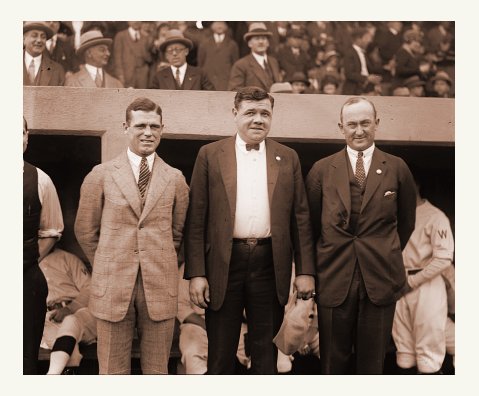 Only Babe Ruth (middle) and Tris Speaker (not shown) created more runs per game in the American League from 1920 to 1922 than Sisler (left). Ty Cobb (right) was fourth over that period.
Then, suddenly, for one long season, it all came to a crashing halt for Sisler and the Browns. In 1923 severe sinusitis infected his optic nerves, afflicting him with double vision and forcing him to miss the entire season. The Browns slumped to a 74-78 record and a fifth-place finish without their star batter. Despite only falling below .300 once for the remainder of his career, Sisler would never be the same hitter that he was before the illness.
“All season long I suffered,†Sisler said about 1923. “I felt sorry for the fans, for my teammates, for everyone, except for myself. I planned to get back into uniform for 1924. I just had to meet a ball with a good swing again, and then run. The doctors all said I’d never play again, but when you’re desperate, when you’re fighting for something that actually keeps you alive—well the human will is all you need.â€
Sisler did, in fact, return to uniform in 1924, not just as first baseman/batter extraordinaire but as manager as well, as he accepted a $25,000 contract for the added responsibility of running the team. He batted only .305—his lowest mark since 1916—and finished 29th in the American League in average, which was tough to swallow for a man who was accustomed to finishing in the top five.
Yankees pitcher Bob Shawkey admitted later that American League pitchers had detected a weakness in Sisler that gave hurlers a huge advantage over the once mighty batsman. “When he was up at the plate, he could watch you for only so long, and then he’d have to look down to get his eyes focused again. So we’d keep him waiting up there until he’d have to look down, and then pitch. He was never the same hitter after that.â€
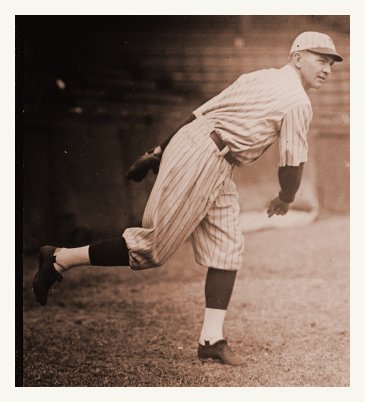
Yankees pitcher Bob Shawkey admitted that American League pitchers took advantage of Sisler’s faulty vision when he returned to action in 1924
Sisler watched his power and speed numbers deteriorate and saw his production slip as he scored and drove in fewer than 100 runs for the first time in four years. The team compiled a 74-78 record for the second straight year but improved to fourth place, 17 games behind the first place Senators. Sisler’s performance in the field began to slip as well as he committed a league-high 23 errors, although he did manage to lead the league in assists for the fourth time in his career.
Some wondered if he’d ever recapture the batting stroke that saw him hit .400 from 1920 to 1922 and .361 over the first eight years of his career. “Two years ago when he was at the pinnacle of his fame—leading the American League in batting, in base-running, voted its most valuable player—he took influenza, developed sinus trouble, underwent an operation,†wrote Time Magazine in March 1925. “His sight was somewhat affected. His right and left eyes ceased to focus evenly; their beams, which should have been parallel, wellnigh met. Thus he came near to being crossed in his career by his own eyes. His batting average of .420 in 1922 sank to .305 in 1924. Now he sees perfectly again, he says. Will he, fans wonder, regain his former prowess?â€
The Browns improved to 82-71 and a third-place finish with the veteran first baseman still at the helm. Sisler began the season with a 34-game hitting streak and watched his average climb back to respectability, finishing at .345, good for a 10th-place tie with Philadelphia’s Sammy Hale. He also amassed the second highest homer total of his career (12), scored 100 runs for the fourth time and drove in 105 runs, also the fourth time he surpassed the century mark. His steals total continued its rapid decline, however, as he swiped only 11 bases, his lowest total since his rookie season in 1915, but he did manage to leg out 15 triples. His fielding continued to suffer, though, despite his fifth assist crown, as he committed 26 errors, the second highest total of his career.
1926 was perhaps the worst of Sisler’s career. His average slipped below .300 for only the second time in his career and the first time since 1915. He hit .290 with a paltry .398 slugging percentage and led the Browns to a dismal 62-92 record and seventh-place finish, a whopping 29 games behind the pennant-winning Yankees. His fielding percentage rebounded—was still an un-Sisler-like .987—but he led the league with 141 double plays. The Browns removed Sisler as manager after the season and turned the reins over to “Dapper Dan†Howley. “I simply wasn’t ready to manage,†Sisler admitted. “I was only 31, and it was too early in my career.â€
1927 would prove to be Sisler’s last hurrah in a Browns uniform. He batted .327—good for 11th in the American League—posted his fifth 200-hit season, smacked 30 doubles for the first time since his illness and surprised everybody by winning his fourth stolen base crown at the age of 34, edging Yankees outfielder Bob Meusel 27 to 24. He led the league in errors again with 24, but paced the Junior Circuit with 131 assists and 138 double plays. That winter, however, St. Louis dealt outfielder Harry Rice, pitcher Elam Vangilder and Chick Galloway to Detroit for outfielder Heinie Manush and Sisler’s successor at first, Lu Blue. No longer in need of Sisler’s services, the Browns unceremoniously sold the future Hall of Famer to Washington for $25,000. After Sisler managed to hit only .245 with no homers and only two runs batted in 20 games, the Senators sold him to the Boston Braves on May 27, 1928 for $7,500.
The move rejuvenated Sisler, who finished with a .331 average on the strength of his .340 mark with Boston. Ironically, one of his Braves teammates, Rogers Hornsby, ended up in Boston for the 1928 season after spending the first 12 years of his career playing in St. Louis for the National League Cardinals. The two all-time greats arrived in St. Louis together in 1915, shared the adoration of Missouri baseball fans for 12 years and were now teammates after brief stints with other teams. Hornsby won the last of his seven batting titles before bolting for Chicago, while Sisler led all National League first basemen in assists—the seventh and final time he would pace the league. Despite boasting two of the top five hitters in the N.L., the Braves finished in seventh place with a record of 50-103.
The 36-year-old Sisler tried to lead the Braves to respectability in 1929, playing in all 154 games and batting .326 with 205 hits and 40 doubles. It was his sixth 200-hit season and the first time he’d reached 40 doubles since 1922, but his efforts went for naught, as the Braves fell to last place in the National League with a 56-98 record, 43 games behind the first-place Cubs. Sisler couldn’t match his success at the plate in the field, however, and his defense continued to deteriorate as he committed a career-high 28 errors at first base, leading the league in miscues for the sixth time in his career.
1930 would bring the final curtain down on Sisler’s major league career appropriately with a .309 average in 116 games. He batted .303 for Rochester of the International League in 1931 and hit .287 for the Shreveport Oilers of the Texas League in 1932 before finally calling it quits. After the 1932 season he ran a printing company in St. Louis, then a sporting goods firm before returning to the majors as a scout and special hitting instructor with Brooklyn and Pittsburgh.
His lost 1923 season cost him a shot at 3,000 career hits as he finished with 2,812—good for 42nd on the all-time list—and his .340 career average has him in 16th place all-time, just .0001 points ahead of Lou Gehrig. But that doesn’t tell the whole story. Bill James, the baseball historian, ran a simulation that predicted Sisler would have finished with about 3,800 hits and a career average of .357 were it not for his eye injury. James suggests that even those figures may be conservative as 4,000 career hits and an average of .362 seem more likely. Considering that only Cobb reached both of those lofty heights, one could reasonably argue that Sisler would have been one of the greatest hitters of all time if not for the eye infection.

Sisler went from a .360 hitter to a .320 hitter after a sinus infection affected his vision in 1923 and his slugging average was almost 100 points lower over the last seven years of his career than it had been from 1916-1922
(James has since backed off the claim that Sisler “is probably the only player other than Gehrig who can reasonably be considered the greatest first baseman ever in terms of peak value,†and wrote in his revised edition of his Historical Baseball Abstract that Sisler was “perhaps the most over-rated player in baseball historyâ€).
Nonetheless, Ty Cobb once called him “the nearest thing to a perfect ballplayer,†and Branch Rickey once said of Sisler, “He was a professional with the bat in his hands. He never stopped thinking. He was a menace every time he stepped to the plate. In the field, he was the picture player, the acme of grace and fluency.â€
Despite his prowess at the plate and in the field, Sisler insisted that his greatest achievement as a ballplayer came on the mound, when he defeated the Washington Senators and his boyhood idol Walter Johnson 2-1 on August 29th, 1915. In fact, of Sisler’s five career victories, two were complete game victories over Johnson.
The greatest Brown of all was inducted into baseball’s Hall of Fame in 1939 with Eddie Collins, Willie Keeler and, appropriately, Lou Gehrig, leading all three with 235 votes. His sons Dick and Dave fashioned major league careers, albeit not as successful as their father’s, while George Jr. served as President of the International League. George Sisler died two days after his 80th birthday on March 26th, 1973 in St. Louis, Missouri.


Damn, that Barney Dreyfuss sure could spot talent. Dig him up and clone him, we need that for the Pirates today.
Dreyfuss and the Pirates got screwed in the Sisler case, IMO. I understand that he signed his first contract as a minor without his parents’ consent (at least that was his story), but if Rickey didn’t coach him at Michigan and didn’t covet him for the Browns, I believe Sisler would have been a Pirate. There were other teams interested in signing him, but I think they would have honored the contract he signed with the Pirates and backed off. Dreyfuss would later “steal” Pie Traynor from the Red Sox, though, so I can’t feel too sorry for him.
Mike, what did Pie Traynor never do?
It was pretty remarkable in his lifetime, and damn near impossible today.
Well, he never played for the Red Sox (what, are you trying to rub it in?), I can tell you that. Otherwise, I’m not sure what he never did. Nothing about his statistical record jumps out at me (other than being pretty damn good).
He never missed a game due to an injury?
You are just TOO baseball oriented. He never drove a car. He walked EVERYWHERE. He claimed that’s what kept him in such great shape. He’s the only person I know of in the 20th century who refused to drive a car. He stayed an employee of the Pirates until he died, and he kept on walking to work until the end. I guess he thought they were unsafe.
If he walked everywhere and was in such great shape can I assume he never missed a game due to an injury? ;-)
My grandfather was the same way. He walked miles a day up until the day he died and he lived to be older than 90. He was so well-known and admired in my hometown the city awarded him a plaque and had it installed on a wall on which he’d sit and rest until he was ready to complete his journey. Now when people pass that particular spot they can remember him.
That’s cool about Traynor. I’d never heard that before.
I grew up hearing great stories about George Sisler and his sons Dick and Dave. I played baseball as a kid and never understood why my mom would tell me all these stories about these ballplayers and tell me that i reminded her of them. then she told me that George Sisler was my Great Uncle and Dick and Dave were my cousins. My mom’s maiden name was Sisler. Pretty cool.
Apparently, Sisler was also ambidextrous. He played 2 games at 3B and 2 at 2B. Most people assumed he was an oddity, a lefty playing 3B and 2B, but apparently there is a photo of him playing 2B, and the glove is on his LEFT hand.
I got a bunch of free stuff in carmell because George is related to me, my family has lots of pictures and we bought the book written about him. Anyway, he was a good baseball player and that ichero that beat his record shouldn’t have beaten him because of different rules and different weights of bats used today.