


Ducks On the Pond; Goose Eggs On the Scoreboard
February 22, 2026 by Frank Jackson · 2 Comments
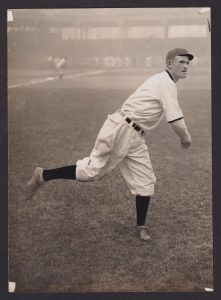
Cubs hurler Larry Cheney tossed a 14-hit shutout against the Giants in 1913.
Theoretically, a pitcher could give up three hits every inning and maintain a shutout. A 27-hit shutout is conceivable but virtually impossible. Of course, in an era when a complete game is a rarity, musing about complete game shutouts is an exercise in nostalgia.
If the complete game shutout were a species, it would be on the endangered list. In 2025 all it took for a pitcher to make the leaderboard was one shutout (five in the NL, 8 in the AL). Same for 2024, 5 in the NL but 11 in the AL. In 2023, however, Gerrit Cole led MLB with two – count ‘em, two! – shutouts. You have to go back to 2017 to find a pitcher with three (Corey Kluber), and a half-century to find a pitcher (Jim Palmer) who reached double-digits (10) in complete game shutouts. Today’s “aces” are to pitching what shrinkflation is to economics.
Once upon a time you could scan the sports section of your daily newspaper from April through September and discover that such-and-such pitcher had thrown a “one-hit shutout,” a “two-hit shutout,” a “three-hit shutout,” etc. Complete game shutouts didn’t happen every day (with the possible exception of the 1968 season) but they weren’t rare.
Not all shutouts are created equal, however. The fewer hits yielded, the more prestigious the achievement. After all, the one-hitter is no-hitter adjacent, so that is noteworthy. Of course, it stands to reason that the fewer the hits the fewer the baserunners and the greater the likelihood of a shutout. And that leads us to two of the most unlikely shutouts of all time.
The very idea of a 14-hit shutout is preposterous. After all, when Christy Mathewson pitched three shutouts in the 1905 World Series, he yielded 14 hits TOTAL. Nevertheless, yielding 14 hits in one complete game shutout has happened – twice in fact. And it was done by guys you’ve probably never heard of.
The name Larry Cheney doesn’t resonate in baseball circles today but it probably did, at least in Chicago households, when he won 67 games in his first three seasons with the Cubs. As a 26-year old rookie in 1912, he matched his age in victories, tying Rube Marquard for the league lead in that category while leading the league in complete games with 28. He added 21 wins (and 7 saves) in 1913. On September 14th of that year he faced the Giants at the West Side Grounds in Chicago. On that day he emerged victorious, the Cubs winning 7-0, despite the fact that the Giants outhit the Cubs 14-11. A transcription of John McGraw’s post-game commentary about the game would surely be entertaining.
The first Giant batter, Fred Snodgrass singled, so as broadcaster Curt Gowdy was wont to say, “There goes your no-hitter.” Immediately afterwards, Cubs second baseman Johnny Evers was ejected for “discoloring the baseball.” To add drama to his exit, he hurled the ball out of the ballpark. So the fans (a Sunday afternoon crowd estimated at 24,000) might have surmised that they were in for an unusual afternoon.
Two hours later Cheney had yielded 14 hits, including three doubles, but no runs. He helped his cause by not giving up any walks. His achievement was a long way from a no-hitter, but pitching a 14-hit shutout (that’s 1.6 runners per inning) is a rarer achievement than a no-hitter. All those ducks on the pond and not one waddles across home plate? What are the odds, Vegas? Pretty slim, I’ll wager.
It is ironic that Cheney walked no batters because his Achilles heel was control. Though he led the league in wild pitches during his 1912-1914 glory days, his victory total overshadowed that flaw. It was difficult to overlook his league-leading total of 140 bases on balls in 1914, however, even though he won 20 games. Cheney’s lack of control irritated Cubs manager Roger Bresnahan, who sent him packing to the Brooklyn Robins late in the 1915 season. There he got his second wind, winning 18 games with a 1.92 ERA for the pennant-winning Robins in 1916. Nevertheless, that season he embarked on another three-year streak of leading the league in wild pitches.
In 1917 the Robins slipped to 7th place. Cheney’s decline was less dramatic (8-12) but he still showed flashes of brilliance. On August 22nd, he participated in a 22-inning game (the longest in major league history at the time) against the Pirates at Ebbets Field. When Cheney came into the game in the top of the 8th inning, he didn’t know he would be out there for 13 innings. Though he pitched scoreless ball (giving up 9 hits), he got neither a victory nor a save, as the game remained a 5-5 deadlock when he left after the 20th inning (the Robins won 6-5 in the bottom of the 22nd inning). He didn’t get the victory (Rube Marquard did) but it wouldn’t have happened without him. He threw the equivalent of a 13-inning shutout.
Cheney’s last season (1919), split between the Robins, the Braves, and the Phillies, was forgettable with a composite record of 3-10 and 4.18 in 129.1 innings. After nine years in the National League he had fashioned a record of 116-100 to go with a 2.70 ERA. Not a bad deadball era career.
Cheney’s 14-hit shutout was unique at the time. But it remained so for only 15 years. His feat was duplicated by Milt Gaston in 1928. Like Cheney, Gaston enjoyed a long career (11 years, 1924-1934). He toiled for the Yankees, Browns, Senators, Red Sox, and White Sox. His record (97-164), however, is less than impressive, as is his career ERA (4.55). Perhaps his greatest achievement was living to be 100, quite a distinction given the life expectancy for men born in 1896. If you were born that year and lived long enough to read about Ted Williams’ .406 season and Joe DiMaggio’s 56-game streak in 1941, you were living on borrowed time after that.
Gaston led the American League in losses in 1926 with 18 and in 1930 with 20. In 1927 he led the league in earned runs yielded. Yet during his career he somehow managed to pitch 128 complete games and 10 of them were shutouts. Given his career record, it is surprising he never spent a day in the minor leagues. At the age of 28 he debuted with the 1924 Yankees after excelling in semi-pro ball. Pitching mostly out of the bullpen, he fashioned a 5-3 record.
Pitching for the Browns the following season, he was 15-14. It was his highest victory total – and it was the last season he had a winning record. From 1926 through 1934 he was underwater. In fairness, during that span he never played for a winning team. In fact, many years his teams didn’t even rise to mediocrity. He spent three seasons with 7th place teams (1926 and 1927 Browns, 1932 White Sox) and two with last-place teams (1930 Red Sox and 1934 White Sox).
In Gaston’s final season (1934) with the White Sox he somehow was allowed to pitch 194 innings despite a 5.85 ERA. Actually, that mark wasn’t particularly egregious since the staff ERA was 5.40, which helps to explain the Chisox’s 53-99 record. After the season, Gaston, age 38, was released and that was the end of his career.
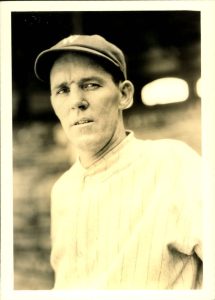
Senators pitcher Milt Gaston threw a 14-hit shutout against the Indians on 1928.
In 1928 Gaston was experiencing a particularly unimpressive season (6-12, 5.51 ERA). It was his only season with the Washington Senators, who weren’t that bad (4th place, 75-79). On July 10th of that year in the second game of a Tuesday afternoon double-header, Gaston outdid himself. He whitewashed the Indians while yielding 14 hits, including two doubles and a triple.
For good measure, he threw in a couple of walks. So that’s 16 base runners in 9 innings or 1.8 per inning. As was the case with Cheney’s shutout, the first batter had singled, so once again, there goes your no-hitter. Though the Indians were outscored 9-0 they outhit the Senators 14-13. Like John McGraw, Indians manager Roger Peckinpaugh was probably beside himself.
Oddly enough, there was a third 14-hit shutout – but with an asterisk. On July 14, 1916 the Red Sox failed to score against the Browns’ Ernie Koob – who was on the mound for 17 innings! He yielded 14 hits plus 3 walks = 17 base runners, or an average of one per inning. So while Koob’s feat is certainly impressive he wasn’t in as much danger of yielding a run as Cheney and Gaston. And let’s not forget Koob’s opposite number, Carl Mays, who matched him for 15 innings, yielding 9 hits and walking 8, before yielding to Dutch Leonard. In one of the greatest anticlimaxes in baseball history, the game ended in a scoreless tie when it was called on account of darkness.
14 hits, however, is not the upper limit in extra-inning games. On July 10, 1901 the Pirates’ Jack Chesbro yielded 15 hits on his way to a 1-0 victory over the Boston Beaneater at Exposition Park in Pittsburgh. Chesbro hurled 12 innings that day. That’s works out to 1.25 runners per inning. Pity Boston starter Bill Dinneen who went the distance and took the loss on an unearned run in the 12th inning. Chesbro went on to the Hall of Fame, Dinneen did not. He had four 20+ win seasons but his overall record was 170-177. Notably, he won three games for the Red Sox in the first World Series in 1903. As soon as he retired as a player (after the 1909 season) he returned to the playing field as an umpire, working eight World Series and the first All-Star game in 1933. A real baseball lifer! Nice work if you can get it. As Robert Mitchum once said of movie acting, “It sure beats working.”
Another 15-hit 1-0 victory was authored by the Senators’ Walter Johnson on July 3, 1913. It took him 15 innings to defeat the Red Sox at Fenway, so he yielded an average of one hit per inning. The hard-luck loser was Ray Collins who pitched 14 shutout innings, faltered in the 15th, and finally coughed up a run. Johnson’s HOF credentials do not need to be listed for this readership. It is interesting to note, however, that Johnson’s 15-inning effort had no effect on his subsequent performances. He logged 346 innings and 36 victories in 1913.
So let’s recap: 14 hits is the record for a 9-inning shutout, 15 hits for 10-17 innings. Is it possible that one day a 16-hit shutout will go into the books? Probably not in my lifetime (full disclosure: the author is a boomer). But probably not in yours either, whether Generation X, Y, Z, XX, XY, LGBTQ or whatever. If it does happen, it will surely be by committee, not achieved by one man. Once we had mighty men of old, giants in the earth. Today we have pitch counts and Tommy John surgery. Of course, we may not have major league baseball at all in 2027, but that is another story entirely.



John Tudor had 10 shutouts in 1985.
The longest game in major league history, as of 1917, was 24 innings: https://www.retrosheet.org/boxesetc/1906/B09010BOS1906.htm