An In-Depth Look at a One-Eyed Major Leaguer
May 3, 2026 by Frank Jackson · Leave a Comment
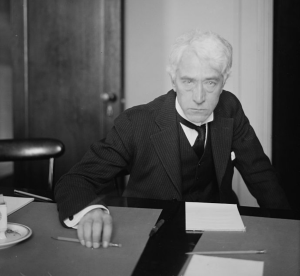
MLB Commissioner Kenesaw Mountain Landis
Much has been written about baseball during World War II when the military draft stripped rosters of all able-bodied men. While most minor leagues suspended operations, the major leagues soldiered on, so to speak, thanks to President Franklin Roosevelt’s famous “green light” letter to Baseball Commissioner Kenesaw Mountain Landis. Reasoning that baseball would boost morale on the home front, FDR urged major league baseball to maintain operations during the war.
With all that major league talent gone for the duration, major league rosters were rife with men who would not have been there in peacetime. Over-the-hill veterans and 4Fs were commonplace. I don’t think “Hire the Handicapped” was a policy back then, but MLB certainly did so. The most famous example was Pete Gray, the one-armed outfielder who toiled for the St. Louis Browns in 1945. Equally remarkable, though much less celebrated, was Paul O’Dea, the Cleveland Indians’ one-eyed outfielder.
Having two good eyes would seem to be as essential to playing baseball as having two arms. Imagine losing not just depth perception but a big chunk of peripheral vision. The brain can compensate to some degree, and you could probably continue to function so far as routine tasks go – but playing professional baseball? A huge drawback in the field or at bat. Nevertheless, O’Dea beat the odds. In fact, he became a baseball lifer.
O’Dea came into the world on July 3, 1920, in Cleveland. He graduated from West Technical High School in Cleveland in 1938 and immediately signed with the Indians and was sent to one of their lowest affiliates (they had six Class D teams!), the Fargo-Moorhead Twins of the Northern League. He batted and threw left-handed. Though heavy-set (6 ft, 200 lbs.), he was not a power hitter.
O’Dea’s professional playing career began before he turned 18. The results for half a season in 1938 were good: a .362/.382/.515 slash line. Promoted to the Class C Springfield (Ohio) Indians of the Middle Atlantic League in 1939, O’Dea played a full season and hit .342 with a career-best 8 home runs. The big-league Indians took note and invited him to spring training in Fort Myers in 1940.
Obviously, this invitation had the potential to be a pivotal event in his baseball career – and it was, but not in a positive way. O’Dea was struck in the right eye by a foul ball and lost sight in that orb.
The Indians stuck with O’Dea but what to do with him? He did come back in 1940, though he remained at Class C (the affiliation shifting to Flint of the Michigan State League), where he hit .344, albeit in just 96 AB. This was certainly encouraging, but could he keep it going in the future?
In 1941 O’Dea was all over the minor league map. He played at Class C (he returned to Flint and also played for Charleston (WV) in the Middle Atlantic League), Class B (Portsmouth (VA) of the Piedmont League) and Class A (the Wilkes-Barre Barons of the Class A Eastern League).
He spent most of his time (195 AB) at Portsmouth where he hit a mere .226. But in limited at bats (86) at Wilkes-Barre he hit .326. For the season, he hit a composite .254. O’Dea wasn’t embarrassing himself, but it was debatable as to what level of play was a good fit for him.
In 1942 the Indians chose to send him to the Class B Cedar Rapids Raiders of the Illinois-Indiana-Iowa (typically referred to as the Three-I) League in 1942. One wonders if it occurred to O’Dea that the league had two eyes more than he did.
At any rate, he spent the entire season there, helping the Raiders win the league championship. In part-time duty (245 AB) he hit .261. He had even been called upon to pitch in four games.
O’Dea had held his own but not excelled at Class B. Did he deserve a promotion or not? The question was moot since most minor leagues suspended operations in 1943. The Indians had just three affiliates that season. O’Dea was too good for the Class D Batavia Clippers of the short-season PONY (Pennsylvania-Ontario-New York) League. Did he deserve to be promoted back to Class A Wilkes-Barre? He certainly wasn’t good enough for the Double-A Baltimore Orioles of the International League. Playing for Cleveland was out of the question – or was it?
In 1943 the Indians were not the only team in town. As was the case in many large cities, semi-pro leagues were alive and well. A five-year minor league veteran, though he was only 22 years old, O’Dea was able to keep his hand in the game by playing semi-pro ball in the Indians’ backyard.
When O’Dea was born, the city billed itself as “The Sandlot Capital of the World.” Enormous crowds packed Brookside Park (a municipal park, not a ballpark) to watch amateur teams. For more information, see “Cleveland’s Brookside Park: Not a Mistake and Not on the Lake” (posted on this web site on April 18, 2023).
In fact, former major leaguers occasionally appeared on such teams. The first baseball game ever played at Municipal Stadium in 1931 was a match-up of amateur teams, both sponsored by Shriners chapters. Among the players was Rube Marquard, an 18-year veteran (winner of 201 games) whose major league career ended after the 1925 season, and Lee Meadows, a 15-year veteran (winner of 188 games) who was just two years removed from the Pittsburgh Pirates.
Every year Municipal Stadium hosted a tournament of amateur teams to benefit the Cleveland Baseball Federation, a non-profit group that funded sandlot baseball programs. So, playing semi-pro ball in Cleveland in 1943 wasn’t exactly under the radar and was a pretty good way for a career minor leaguer in limbo to keep his hand in the game.
I can’t turn up any internet data on O’Dea’s 1943 season. I can’t tell you the name of his team or how well he did. He must have done pretty well, however, because the Indians brought him back in 1944 and promoted him – not to Single-A or Double-A ball but to the major league roster!
Ironically, in late April O’Dea’s number was called by Uncle Sam. Obviously, he was classified 4F. One might wonder how someone who is fit enough to play major league ball – one eye or not – isn’t good enough to join the military. Of course, if you were a soldier on patrol and you had to ask your one-eyed buddy to cover you, you might have a different opinion. Having one eye is a handicap in baseball playing and soldiering but only in the latter is it a matter of life and death.
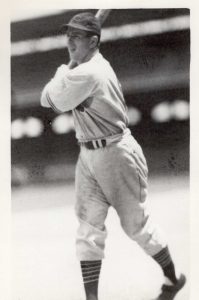 Of course, for a one-eyed man to make a major league roster – even during the manpower-depleted World War II years – was an accomplishment. Even if he sat on the bench, it was remarkable. So, it was a pleasant surprise when O’Dea hit .318 in part-time duty (198 plate appearances). He learned to play first base and even made a few appearances on the mound. The Indians, however, were also-rans (72-81), finishing in a tie for fifth place with the Athletics. The big story in the American League in 1944, of course, was the one and only pennant for the St. Louis Browns.
In 1945, however, the results were not so benevolent. O’Dea hit just .235 (52 for 221). He did get his only major league home run (off Don Black of the A’s) on May 19th in a 2-1 victory at Cleveland’s League Park. The Indians finished in fifth place again but above .500 (73-72). One might note, however, that when the Indians played the Browns on June 8th in Cleveland, baseball history was made. Pete Gray was in left field for the Browns and O’Dea was in right field for the Indians. Without researching the topic, I feel confident it was the first major league game with a one-armed player and a one-eyed player.
Since the war ended before the end of the 1945 season, O’Dea likely figured out his major league career would be short-lived. He did report to spring training in Clearwater in 1946 but the Indians released him before the regular season. So he resumed his minor league career. As eventful as his career had been, he still had youth on his side. He was only 25.
O’Dea played 44 games for the Milwaukee Brewers and the Toledo Mud Hens of the American Association in 1946 (the former was a White Sox affiliate, the latter a Browns affiliate). Of course, the Triple-A rosters were also stocked with returning veterans, so his playing time was limited. Then came another pivotal moment in his career.
In 1947 the Indians invited him back as a player-manager for their minor league system. So at age 26, his managerial career was launched. Over the next few years he managed three Class C teams (Burlington (IA), Rockford, and Fort Smith) and one Class D team (Enterprise, AL).
O’Dea’s playing career continued through 1951. He retired with 602 hits and a .317 average for his minor league totals. That same year, while managing the Fort Smith Indians of the Class C Western Association, he appeared in 24 games as a pitcher, logging 77 innings with a 3.74 ERA. Granted, it was Class C, but he must have wondered if he had been miscast as a position player. Would he have fared better as a one-eyed pitcher than a one-eyed position player?
Having retired as a player, he continued his managerial career. During the rest of the 1950s, he managed one Class C team (Fargo-Moorhead) and three Class D teams (Cocoa, Batavia, and Selma). At age 40, he retired as a manager. He still drew a paycheck from the Indians, however. He began as a scout and worked his way up to director of minor-league operations. Somewhere along the line, he had managed to get a degree from Cleveland’s Case Western Reserve University. He died, appropriately enough, in Cleveland in 1978.
When O’Dea reached the major leagues in 1944 it was an event worthy of Ripley’s Believe It or Not. Ripley featured Pete Gray in his comic strip but somehow missed out on O’Dea. Perhaps because his handicap was more visible, Gray received much more publicity than O’Dea. O’Dea might have attracted more attention if had sported an eyepatch. Had he played for the Pittsburgh Pirates, he would have been the face of the franchise!