One Man, One Inning, and a Threesome of Four-Baggers
July 12, 2026 by Frank Jackson · Leave a Comment
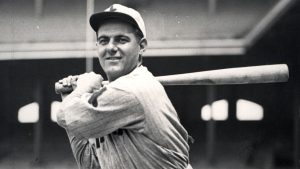
Gene Rye with the Boston Red Sox in 1931
Baseball offers examples of otherwise obscure players, whether journeymen or flashes in the pan, making headline news on a given day. Don Larsen pitched 14 years in the big leagues, but if not for that perfect game in the 1956 World Series, he might have been best remembered for his 3-21 record with the Orioles in 1954.
Bobo Hollomon threw a no-hitter in his first start before fading away with a 3-7 lifetime record. Cesar Gutierrez, a .233 lifetime hitter who played the equivalent of one full season (600 plate appearances) in his four-year career, holds the modern era record for most hits in a game with seven.
The same is true of minor league ballplayers only more so. Improbable feats by obscure players are rendered even more obscure because the leagues are minor even though the feats may be major. But there are some minor league feats that are so unusual they never quite fade away from baseball lore. Consider the case of Gene Rye.
Chicago-born (in 1906) Eugene Rudolph Mercantelli Rye discovered that sportswriters had mercifully shortened his name to Gene Rye. Compacting was nothing new to Rye, who stood 5’6” and weighed 165 pounds (think Jose Altuve). Even in those days, that was small for a ballplayer. Given his last name, and the popularity of rye whiskey during Prohibition, the nickname Half-Pint was inevitable.
Rye’s minor league record had been unimpressive during his first three years (1925-1927) with Class D teams, but he finally moved up to Class C with the Winston-Salem Twins of the Piedmont League. He hit .289 with 12 home runs in 1928. That season, Frank “Stump” Edington, in his final year (of 18) as a minor league player, had taken on additional duties as manager of the Raleigh Capitals in the Piedmont League. Edington had played for the 1927 Waco Cubs of the Texas League in 1927. He thought Rye’s left-handed swing was tailor-made for the dimensions at Katy Park in Waco and recommended him to the Cubs.
So, in 1929 Rye found himself a member of the Waco Cubs. He more or less re-created his 1928 season with Winston-Salem, which was not good enough for a promotion but good enough to be invited back to Waco for the 1930 season, when he distinguished himself with a .367 average and 26 home runs.
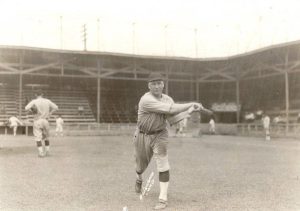
Del Pratt
Rye likely benefited from the tutelage of Cubs skipper Derrill “Del” Pratt. A 42-year-old player-manager, he had accumulated 1,996 hits and logged a .292 batting average in a 13-year MLB career with the Browns, Yankees, Red Sox and Tigers – not to mention more than 1,000 hits for various minor league teams.
The highlight of his minor league career was winning the Texas League Triple Crown (.382, 32 HR, 140 RBI) with the Cubs in 1927. After attending high school in Alabama as well as college at Alabama Polytech (now Auburn) and the University of Alabama, he began his professional career with the Montgomery Climbers of the Southern Association. In 1972 he was enshrined in the Alabama Sports Hall of Fame.
Rye was not the only ballplayer enjoying a good year in 1930, a season noted for offense not just in the big leagues but also in the minors. While Rye’s stats were outstanding, the most memorable achievement of his season (and of his career) occurred in an August 8th 20-7 victory over the Beaumont Exporters. Rye hit three home runs in that game. A notable achievement but one equaled by many batters over the years. Rye, however, clouted three home runs in one inning. It was the only time (and remains the only time) in baseball history at any level that anyone had done so. Of course, hitting three home runs in one inning means one had to come to bat three times in one inning, a rarity in itself, which indicates a remarkably productive inning.
The game had been routine for the first seven innings. The Cubs were trailing 6-2 when they came to bat in the bottom of the 8th. Rye’s first home run, an opposite (left) field solo shot, was hit off Gerald Mallett. Mallett had a curious 10-year career. As a two-way player, 1930 was the only season he was primarily a pitcher, logging a 10-6 record in 139 innings. That doesn’t sound too bad, yet after that season he spent the rest of his career as an outfielder, save for one game in 1935. When he retired after the 1937 season, he had a .303 career average (698 for 2,301) compiled at every level of minor league ball.
Mallett gave way to Walter Newman, a slender (6’, 154 lbs) right-hander who had fallen on hard times. Newman logged an 18-14 record in 1927 with San Antonio but his next two seasons in the Texas League were forgettable. The same was true of his 1930 season, which he would finish with a 9-16 record and a 6.00 ERA in 213 innings.
Rye showed Newman no mercy, launching a three-run homer to right field. When the lineup turned over again and Newman was still on the mound, it was probably an admission that the game was out of reach. Newman was there to finish the game and save any further wear and tear on the bullpen. Tomorrow is another day but first you have to finish today.
When Rye stepped up to the plate for the third time in the inning, the bases were loaded. Fate was daring him to improve on what he had already accomplished. He responded by launching a grand slam over the right field wall. When the smoke had cleared, Rye, had set a professional baseball record for most home runs in one inning. He holds the Texas League record for most RBIs (8) in an inning but has to share the pro ball record with Fernando Tatis, Sr., who hit two grand slams for the Cardinals in one inning in 1999.
Rye also set single-inning Texas League records for total bases (12) and RBIs (8) in one inning and tied the record for runs scored (3) in one inning.
By the time the third out was registered, Rye and his teammates had logged 21 plate appearances, 18 runs, 16 hits, 6 walks, 2 errors, and 1 wild pitch on the way to that 20-7 victory. In addition to Rye’s round-trippers, one each was hit by second baseman Tony Piet and first baseman Charley Stuvengen. At season’s end Piet was tied with Rye for the team lead with 26; Stuvengen was right behind with 25. Despite all that firepower, the Cubs could do no better than a 68-81 record and a sixth-place finish in 1930.
That 18-run inning is not a league record, however. In 1896 the Fort Worth Panthers of the Texas Association (as the Texas League was called that year) plated 19 in the 8th inning of a June 29th contest against the Galveston Sand Crabs. The Panthers finished the year at 71-29, so they probably had a fair share of offensive outbursts that season.
The chief reason Rye’s achievement remains unique is that few hitters have the opportunity to match it. First of all, coming to bat three times in an inning requires your team to bat a round twice and then some. So just coming to bat three times in one inning is a rare occurrence. And if you were fortunate enough to experience that rarity, you would have to hit home runs in your first two at bats to be in a position to match Rye.
Sadly, few fans were on hand to witness Rye’s big night (the first Texas League team to install lights, the Cubs had done so seven weeks before). I don’t have any attendance figure for the game, but the Cubs averaged 840 per game in 1930. The game was played on a Friday night so there might have been more than that, but since the Cubs were not in the pennant race, I don’t think Wacoans were turning out in droves at that stage of the season.
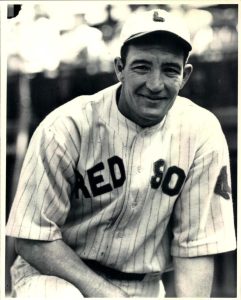
Earl Webb
The news of Rye’s achievement did reach the major leagues, however. Understandably, the last-place Red Sox (52-102, 50 games behind the pennant-winning A’s) were interested in him. Though offense was rampant in major league ball in 1930, the Red Sox were last in the AL in average (.264), runs (612) and HR (47). The team’s home run leader was Earl Webb with 16. When they assembled for spring training in Pensacola in 1931, there were numerous job opportunities and Rye was one of the applicants.
Given Rye’s physiology, comparisons to Hack Wilson (also 5’6” but 25 pounds heavier), who hit 56 home runs and drove in 191 in 1930 for the major league Cubs, were inevitable. If young Rye (24 years old) could summon up half that many home runs and RBIs, the Red Sox would have been more than happy. Unfortunately, Rye broke his wrist in spring training.
Though he went north with the Red Sox, his wrist was not fully healed when the season began. He had 7 singles in 41 at bats, which translates to a slash line of .179/.220/.179 for 1931 – and for his major league career. After 17 games he was returned to the Texas League, same franchise, new location (the Waco Cubs were now the Galveston Buccaneers). After a few at bats he sat out the rest of the season to allow his wrist to fully heal.
He returned in 1932, however, and spent the rest of his career at Class A ball (in addition to Galveston, the Houston Buffaloes, the Elmira Red Wings, and the Davenport Blue Sox) while also logging time with the Logan Squares, a renowned semi-pro team in Chicago. After 12 seasons his minor league career average was .305 but in 1936 at age 29 his hopes of advancing were nil. So, he retired.
Rye returned to the Chicago area, where he would live another 44 years. One wonders if his thousands of co-workers (he was a machine operator) at Teletype Corporation in suburban Skokie knew of his unique contribution to the baseball record book.
Even in Waco, the name Gene Rye would probably draw a blank today. Yet it is possible to walk in his footsteps. Long after Katy Park was torn down, Chip and Joanna Gaines of the Fixer Upper TV series opened Magnolia Market at the Silos in Waco. A large portion of the development overlaid the old footprint of Katy Park. The location of home plate is now serving as home plate in a wiffle ball park. So, visitors can stand in the batter’s box where Rye launched his three bombs in 1930.
Unexpectedly, there are statues of Babe Ruth and Lou Gehrig on the premises. So, what are they doing here? In 1929 they played an exhibition game in Katy Park. Rye does not have a statue because he does not have the stature, physically or metaphorically, of Ruth and Gehrig – yet he achieved something, albeit in minor league Waco, that no one has done before or since.
The centennial of Rye’s achievement is only four years away. Some sort of commemoration should be held at that wiffle ball park on August 8, 2030, to commemorate Rye’s unique achievement. I understand there are a number of wiffle ball leagues that hold tournaments and that Kevin Costner actually owns a team in professional Big League Wiffle Ball.
So why not make Waco to wiffle ball what Omaha is to college baseball? There’s even a suitable sponsor (Dr Pepper, founded in Waco) waiting in the wings. How about a home run derby in 2030, Waco? It just might become an annual event.