O Brother Billy, Where Art Thou?
September 6, 2026 by Frank Jackson · Leave a Comment
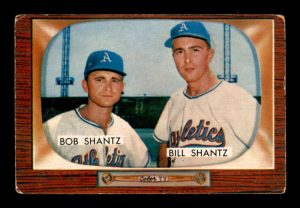 Given the supply/demand employment gap in big league baseball (780 roster spots / →∞ aspirants), the odds of making it to the Show are long. The odds against brothers doing so are even longer. As for the odds of brothers making the Hall of Fame…well, Paul and Lloyd Waner did it, but I wouldn’t hold my breath waiting for it to happen again.
Typically, there is always a talent gap even when both brothers are outstanding. It could be between Hall of Famers (e.g., Gaylord Perry, Phil Niekro) and brothers who are very good but not great (Jim Perry, Joe Niekro), or the very good and the merely good (Ken and Clete Boyer). Then there are the vast gulfs between Hank and Tommie Aaron, or José and Ozzie Canseco (supposedly identical twins). Finally, there is the lesser brother who has been forgotten. Consider the case of the Shantz brothers.
Bobby Shantz had a creditable 16-year career. He won 119 games, lost 99 and logged a 3.38 lifetime ERA. He made headlines with the Philadelphia A’s in 1952 when he led the league in wins (24), winning percentage (.774), WAR (8.8), and WHIP (1.048), which earned him the AL MVP award.
His diminutive stature gave his achievement a David vs. Goliath vibe. At 5’7” and 139 pounds, he defied the odds just by making a big league roster (he made his debut in a relief appearance on May 1, 1949). Even now, he continues to defy the odds. Mark your calendar for September 26th when he will be feted by MLB on the occasion of his 101st birthday. (Hope this posting doesn’t jinx him.)
Then there is the other Shantz. You say you didn’t know Bobby Shantz had a younger brother who played major league ball? Neither did I. So, let’s get acquainted with him.
Like Bobby, Wilmer Ebert (his mother’s maiden name) Shantz, Jr. was born in Pottstown, Pennsylvania. Wilmer, Sr. had been a semi-pro player. His father in turn had also played ball and once was part-owner of a local minor league team (Pottstown had brief flirtations with minor league teams in 1896 and 1932).
Born on July 31, 1927, Wilmer, a catcher, was popularly known as Billy. Standing 6’1”, he was a contrast with Bobby. He weighed in at just 160 pounds, so he was rather slender for a catcher. Not surprisingly, he had been a backyard batterymate for his older brother. Like Bobby, he attended Pottstown High School. Unlike Bobby, however, he dropped out after the tenth grade.
When A’s scout Harry O’Donnell signed Bobby to a minor league contract, he was persuaded to sign Billy also. Both started the 1948 season with the Lincoln A’s in the Class A Western League. Billy, however, was soon sent down to the Moline/Kewanee A’s of the Class C Central Association.
After a sojourn with the Martinsville A’s in the Class B Carolina League, Billy worked his way back to Lincoln in 1949 and remained there through 1952. Given his stats during that era, it doesn’t appear that he lit up the Western League offensively or defensively. Maybe he called a good game. For whatever reason, he was promoted to the Triple-A Ottawa A’s of the International League in 1953. Given his mediocre record in Single-A ball, it may seem puzzling as to how he skipped over Double-A ball. The mystery has a simple explanation. In 1953 the A’s did not have a Double-A affiliate.
Billy did not distinguish himself at Ottawa in 1953. His slash line of .227/.264/.274 would not seem to warrant promotion to the big leagues, but catching was not a strong point for the A’s in 1954, so Billy made the team. Joe Astroth logged the most games while Billy and Jim Robertson backed him up.
At age 26, Billy had a decent rookie season, improving his slash line to .256/.326/.366, his best showing since 1948 at Moline/Kewanee. Unfortunately, brother Bobby was injured and pitched a mere 8 innings in 1954, so I can’t say for sure that the Shantz boys were big-league batterymates. Well, I could if I wanted to take the time to comb through 156 box scores. I’m curious but not that curious.
Both brothers made the move from Philadelphia to Kansas City in 1955. Bobby logged 125 IP while Billy appeared in 79 games. They were indeed batterymates that season, starting on April 14 against the White Sox at Comiskey Park. Bobby, however, was not at the top of his game (six walks in seven innings) that day. The result was a 7-1 loss.
After that inaugural year in Kansas City the brothers went their separate ways. Though Billy had performed adequately as Joe Astroth’s backup in 1955, he was sent down to the Triple-A Columbus Jets. The A’s had bolstered the catching squad by purchasing Joe Ginsberg from the Seattle Rainiers of the Pacific Coast League (later in the season Ginsberg was traded to Baltimore for another catcher, Hal Smith.)
So, in 1956, at age 28, Billy was back in the International League. In 1957 he remained in the league but with the Rochester Red wings, a Cardinals affiliate. In 1958 he was with the Charleston Senators (a Detroit affiliate) of the American Association. In 1959 he was back in the International League, with the Richmond Virginians, a Yankees affiliate. It appeared his playing career had plateaued at Triple-A, but he had a side hustle.
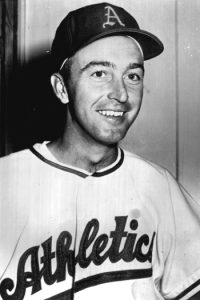
Billy Shantz
After the 1959 season he returned to Panama for winter ball, where the teams were owned by corporate sponsors. He had formerly played with the Carta Vieja (a rum distillery) Yankees of the Panamanian Professional Baseball League, but this time he was managing the Marlboro Cigarilleros (Smokers). He led them to a title in February 1960 (he would do the same in 1962 and 1964.)
He returned to the Richmond Virginians as a player in 1960 and was called up to the Yankees in the middle of the season. Since the Yanks’ catching corps consisted of Yogi Berra, Elston Howard, and Johnny Blanchard, one can only wonder why they called up Billy. My guess is that injuries left them temporarily short-handed. Billy played in but one game on June 29th. He gave Yogi Berra a breather in the top of the ninth inning of a 10-0 blowout of the A’s at Yankee Stadium. Brother Bobby had revived his career with the Yankees, and it would be nice to report that they were reunited in that game. Unfortunately, Jim Coates went the distance for the Yankees that day, so Billy never got a chance to catch Bobby. And he never would again. Billy’s big league career was over. (Bobby soldiered on through 1964.)
At age 33 Billy returned to Richmond in 1961. He played with them again in 1962 before calling it quits. In 1963 he remained with the Yankee organization, managing the Shelby Colonels of the Western Carolinas League.
Coaching with the International League’s Toledo Mud Hens (at the time a Yankee affiliate) in 1966, he dusted himself off to play in 7 games. So ended his playing career. But the next year he was managing the Fort Lauderdale Yankees in the Class-A Florida State League. And there he remained through 1969. Not sure what he did after that, but he died at age 66 on December 13, 1993, in Lauderhill, Florida, which is adjacent to Fort Lauderdale. So, we might surmise he remained in the area after managing in Fort Lauderdale. I can find no information on what he was doing from 1970 till 1993.
In 2010 the Pottstown High School baseball field was renovated and renamed Bobby Shantz Field. I suppose they could have named it Bobby and Billy Shantz Field, but when the name was bestowed, Billy was no longer among the living, and his career was little noted nor long remembered. Of course, he had dropped out of Pottstown High School, so that was likely a buzz kill.
Clearly, Bobby overshadowed Billy in the baseball world. But the bright side of that is that Billy gets the posthumous sound bite ID of being Bobby Shantz’s younger brother. Without that family tie, he would be doomed to the memory hole for eternity.
And I wouldn’t have bothered researching his career.
And you wouldn’t have bothered reading this article.