


The Budding Pete Rose
October 11, 2026 by Frank Jackson · Leave a Comment
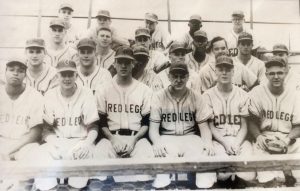
Pete Rose, top row second from the left
Pete Rose died in 2024 without getting a plaque in Cooperstown. Given his 4,256 hits in 24 MLB seasons, he belongs there if anyone does. Ironically, he began his pro career not far from Cooperstown, playing for the Geneva Redlegs of the New York Pennsylvania League in 1960.
After graduating from Western Hills High School in Cincinnati, Rose was signed by his uncle, Buddy Bloebaum, a former minor leaguer (one season with the 1932 Cedar Rapid Bunnies of the Mississippi Valley League) who was a scout for the Reds. Curiously, Rose did not play high school ball in his senior year. Having flunked ninth grade, he had to repeat it, thus exhausting his eligibility after his junior year.
Nevertheless, he played semipro ball well enough to sign for $7,000 with a $5,000 bonus if he made the majors. So, at age 19, Rose was on his way to Geneva, New York. Located at the northern Tip of Seneca Lake, one of several narrow lakes running north to south in the state’s famed Finger Lakes region, Geneva had a population of 17,286 in 1960.
Geneva did not exactly have a rich baseball history. There were a few short-lived attempts at pro ball starting in 1897 (the New York State League), then from 1905 through 1907 (the Empire State League), and in 1910 (the Central New York League). Then nothing till the post-war minor league boom with the Border League (1947-1951). Long-term minor league baseball finally arrived in 1958 when the New York-Penn League came to town with a Cincinnati Reds affiliate.
Founded in 1939 as the Pennsylvania-Ontario-New York (PONY) League, the rebranded New York-Pennsylvania League had six teams in 1960. When MLB deep-sixed the league in 2020, the league had 14 teams in three divisions. Obviously, teams and major league affiliations came and went, and the Geneva franchise went away for good after 1993 season when the Geneva Cubs moved to Williamsport.
When Rose hit town in 1960, the league was comprised of the Geneva Redlegs (curiously, the parent club nickname had reverted to Reds), the Auburn Yankees, the Corning Red Sox, the Wellsville Braves, the Erie Senators, and the Elmira Pioneers (a Phillies affiliate).
Given the low classification of the league (Class D), few of the players had the talent to advance to the major leagues. The exceptions were recently deceased (8/31/26) Rollie Sheldon of the Yankees and Fred Newman of the Red Sox (he actually came up with the Angels, who acquired him in the expansion draft). You might not have heard of the Braves’ Bruce Brubaker (two appearances) or Vern Handrahan (61 IP total), but you probably have heard of catcher Elrod Hendricks, who was a member of the outstanding Baltimore Orioles teams of the 60s and 70s.
And you surely have heard of Dick Allen, who played with the Elmira Pioneers along with his brother Hank, who had a modest seven-year career as a part-time outfielder, and pitcher Paul Brown, who spent parts of three seasons with the Phillies with only a record of 0-8 to show for it.
The dominant team in 1960 was the Erie Senators, who cruised to a league championship with a record of 83-46, 14 games ahead of the runner-up Braves. You might think such a team would include one or two impact players, but that was not the case. The only players to reach the big leagues were Joe McCabe (53 plate appearances in two seasons) and Marty Martinez, who played seven years as a part-time infielder and emergency catcher.
In addition to Pete Rose, the Geneva Redlegs had four players who played in the big leagues. You probably don’t know Jack Cassini, who played eight games with the Pirates in 1949, then returned to the minors, and served as player-manager at Geneva. Ditto for Dave Skaugstad, who had pitched two games for the big-league Reds at age 17 in 1957 but never returned.
You might remember Art Shamsky, who played eight years in the big leagues, including a .300 season with the 1969 Miracle Mets. And you surely recall Tony Perez, who, like Rose, was one of the big cogs in the Big Red Machine of the 1970s and was inducted into the Hall of Fame in 2000.
Like Rose, Perez was in his first year of pro ball. Ironically, he was a second baseman when he came up. Rose was clearly better at the position, so he shifted from the outfield to second base while Perez was sent to third base.
Perhaps the most intriguing name on the roster was Martin Dihigo. No, it was not the old Cuban-born Negro Leaguer who was inducted into Cooperstown in 1977, but his son, who had signed a minor-league contract at age 16 in 1959. He returned to Cuba after a few mediocre seasons.
Though the Redlegs were blessed with so much latent baseball talent, they somehow ended up in last place with a 54-75 record. For the season, the team drew 20,897 paying customers, or 324 per game, so relatively few people witnessed the professional debut of the man who would one day be major league baseball’s career leader in hits.
Shamsky was perhaps the most promising prospect, leading the team in home runs with 18 and RBIs with 86. The leader in hits (133) and batting average (.301) was infielder Marvin Chalmers, something of a mystery man, who disappears from pro ball after 1960 despite a promising start.
Rose and Perez both had OK seasons in 1960. Surprisingly, Perez hit but 6 home runs with a slash line of .279/.355/.401 while Rose scored .277/.385/.343. As that stat evinces, 73 of Rose’s 89 hits were singles. He did, however, lead the team in stolen bases with 18. Yet for some reason Rose was promoted to Tampa while Perez returned to Geneva in 1961.
Actually, both decisions paid off. Rose’s promotion was validated by his 1961 season with the Tampa Tarpons, as he finished with a slash line of .331/.403/.508. Curiously, that power surge was not due to home runs but triples, as he led the league in that regard with 30. In 1962 he was bumped up to the Macon Peaches, where put up a similar slash line.
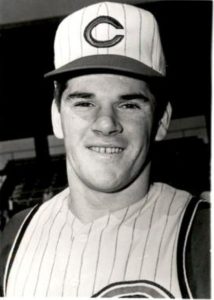 In 1963 he was installed as the Reds starting second baseman and the rest is history. Meanwhile, Perez found his power stroke (27 HR and 132 RBIs) at Geneva in 1961 and began his ascent through the Reds’ system, making his debut with the big club on July 26, 1964.
In 1960 there was nothing to indicate that Rose would have anything close to the sort of career he enjoyed. Nevertheless, the New York-Penn League saw fit to induct Rose into its Hall of Fame established in 2012 (Tony Perez was in the inaugural class). In 2016 Rose was inducted with Jorge Posada, who had retired after the 2011 season, and Dick Allen.
Like Rose, Allen’s pro debut was so-so (.281/.389/.478 with 8 home runs and 42 RBIs. Also, like Rose, he had a checkered past, but not enough to keep him out of Cooperstown. One imagines that Rose’s induction was the subject of debate, as it took him four years to get elected. The league’s HOF is now set in stone, as the demise of the league means there is no one left to nominate and elect candidates.
To date, the NYP League is the only league to induct Rose into its HOF. Though he had better seasons at Tampa and Macon, the Florida State League and the Sally League, respectively, have declined to add him to the ranks of their immortals, probably because of the MLB ban.
After Rose died in 2024, his lifetime ban went away with his life. At some point in the future, Rose’s extracurricular activities may fade away and he will get his plaque in the Hall of Fame in a town not that far (Cooperstown is 125-150 miles from Geneva, depending on which route you take) from where he began his pro career.
One wonders if Rose ever pondered the modest start of his career in Geneva. So close to Cooperstown, yet so far away.





